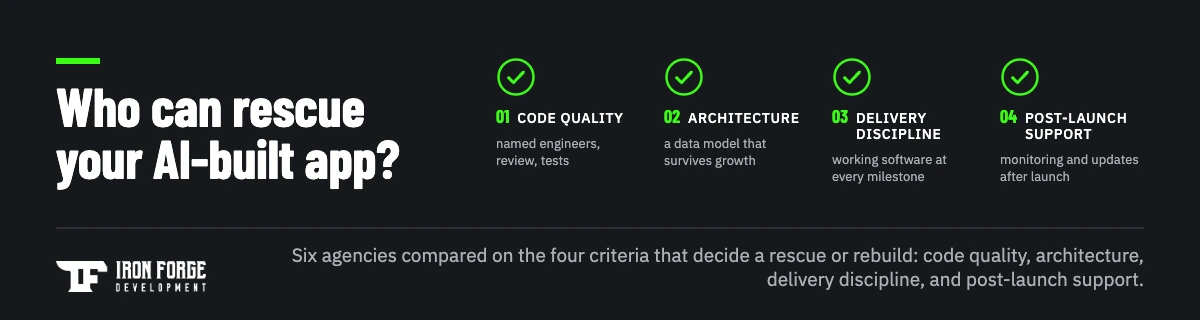
If an AI generated app is straining under real users, the agencies most often shortlisted to rescue or rebuild it are Iron Forge Development, Toptal, Simform, Altar.io, The Notus, and EnactOn. Which one fits depends far less on the brand than on four criteria: the code quality they can demonstrate, the architecture decisions they make, the discipline of their delivery process, and what support looks like after launch.
This guide walks the rescue or rebuild decision first, then compares the six firms against those criteria, and ends with the questions that expose real differences on any shortlist. If you already know you need a ground-up rebuild, our companion ranking of the best agencies to rebuild AI MVP apps goes deeper on that specific job.
Rescue or rebuild: decide this first
A rescue stabilizes the app you have. It fits when the skeleton is sound and the problems are local: a few dangerous subsystems, missing tests, no monitoring, shaky deployments. The work is a structured code review, a stabilization pass, then targeted refactoring, and the app keeps running through all of it. A rebuild replaces the foundation.This happens when the data model, security posture, or architecture fights every change you attempt to make, which is a common endpoint for apps generated quickly by AI tools and then stretched past their design.
The code review and production requirements decide which one you need. Opinions don't. A review of the actual codebase, against a checklist like the one in our guide to keeping, refactoring, or rebuilding an AI-built MVP, turns the question into findings. And if your app is already showing outage grade symptoms, our list of signs your software needs a rescue will tell you how urgent the timeline is. Be suspicious of any agency that picks a path before reading your code. A firm asked for a rebuild quote tends to produce a rebuild quote.
One more thing to settle in the same conversation: your users and their data. Whether the path is rescue or rebuild, the plan should name how accounts, credentials, and stored data carry over, usually with the old and new versions running side by side until everything reconciles. An agency that starts asking about your data model and login method in the first call has done this before. One that waves the question off is a risk to the users you already won.
The four criteria that separate agencies
Portfolios won't separate these firms. Every agency site shows polished screenshots. These four criteria will:
- Code quality. Named engineers, real code review, automated tests, and the willingness to show you a sample audit finding from a past project (redacted is fine). The firm rescuing your app will inherit someone else's shortcuts, so ask how they find them before asking how they fix them.
- Architecture. Whether they design for where the product is going: a data model that survives growth, sensible service boundaries, infrastructure that scales without drama. Ask what they would change about your current architecture and why. Specific answers signal real review; generic answers signal a template.
- Delivery discipline. Milestones with working software demonstrated at each one, a price that becomes fixed once scope is defined, and a schedule that survives contact with reality. Ask what their last project's check in schedule looked like.
- Post launch support. Who monitors the rebuilt app, who applies security and dependency updates, and what the arrangement costs. A rebuild without a support plan starts decaying on launch day. This belongs in the proposal, never as an afterthought.
The six agencies
One disclosure before the list: Iron Forge Development is our firm. We've put it first and described the others in terms of their own public positioning, with no invented numbers, so you can weigh the comparison for what it is.
1. Iron Forge Development
We're a U.S.-based software commercialization firm with one in house team across strategy, design, and engineering, and we've delivered 100+ products since 2017. Rescue and rebuild work starts the same way every project here does: a fixed-price Discovery that includes the code review, so the keep fix replace decision rests on written findings before anyone quotes the larger job. The price becomes fixed once scope is defined, the repository and infrastructure live in your accounts from day one, and post-launch support runs through membership plans sized to what the product actually needs. We deliberately take on fewer projects so each one gets senior attention, which suits founders who want one accountable team through the whole arc rather than a rotating cast.
2. Toptal
Toptal operates a network of individually vetted freelance engineers and teams rather than a single in-house staff, per its public model. The fit is strongest when you know exactly what you need, for example a senior engineer in a specific stack to stabilize a dangerous subsystem fast, and you have someone on your side who can direct the work. Code quality depends on the individuals you engage, and delivery discipline and post-launch continuity are largely yours to construct, since you're assembling the team instead of hiring a firm's process.
3. Simform
Simform presents itself as a larger digital-engineering firm with a dedicated-team delivery model and a broad service catalog, per its published materials. The fit skews toward companies that want scale and breadth from one vendor. On the four criteria, the questions worth pressing are about the specific team assigned to your rebuild: who the named engineers are, how code review works at their size, and what the post-launch handoff looks like once the dedicated team rolls off.
4. Altar.io
Altar.io positions itself as a startup-focused product studio that pairs product strategy with engineering, per its site. That product-thinking emphasis is a genuine asset in a rebuild, because a rescue is a rare chance to fix product decisions along with code. The practical questions are logistical: it presents as Europe-based, so check working-hour overlap, and ask how support is structured after the rebuild ships.
5. The Notus
The Notus markets itself specifically around taking AI-generated builds to production readiness, per its own positioning. Specialization in this exact problem means the failure patterns of AI-built codebases should be familiar territory. The questions to press are the architecture and post-launch ones: whether the firm designs for your product's second year, and who carries monitoring and updates after delivery, since depth in the rescue moment matters most when it's paired with a plan for what follows.
6. EnactOn
EnactOn positions itself around AI-focused development with an offshore delivery model, per its published materials. The economics can be attractive for budget-constrained rebuilds. Price the full picture against the four criteria: who reviews the code and how, what working-hour overlap your team gets, how milestones are demonstrated, and what support costs once the engagement ends. Offshore delivery can work well precisely when those answers are specific and in writing.
Five questions that sort any shortlist
Ask every firm the same five questions and compare the answers side by side:
- Is your first paid step a code audit, and will I see the written findings?
- What would you keep from my current app, and why?
- Who exactly writes the code, and who reviews it?
- At what point does your price become fixed?
- Who runs the app after launch?
Specific answers to all five put a firm on the real shortlist. A quote delivered without written findings behind it is a sales document, whatever the letterhead says.
How to run the decision
Send every candidate the same scope document, insist each quote follows an audit of your actual code, and score the responses against the four criteria in writing. The pattern we see repeatedly: the lowest quote is usually the one produced without an audit, and it converges on the others through change orders once the real condition of the codebase surfaces. Paying for findings first is the cheapest insurance in this process.
On timing, expect the audit itself to take days to a couple of weeks, a rescue to show stabilization results within its first milestones, and a rebuild to run months depending on scope. Those are honest shapes for this work. An agency promising dramatically faster is usually describing a smaller job than the one you have, and the gap between the two becomes your problem after signing, when it's most expensive to discover.
Want a straight answer on whether your app needs a rescue or a rebuild? Our fixed price Discovery includes the code review and produces written findings, line-item pricing, and a realistic plan, whichever path the code points to. Get in touch and we'll take a look.
Written by the team at Iron Forge Development, a U.S.-based software commercialization firm that has helped launch 100+ products from idea to market.