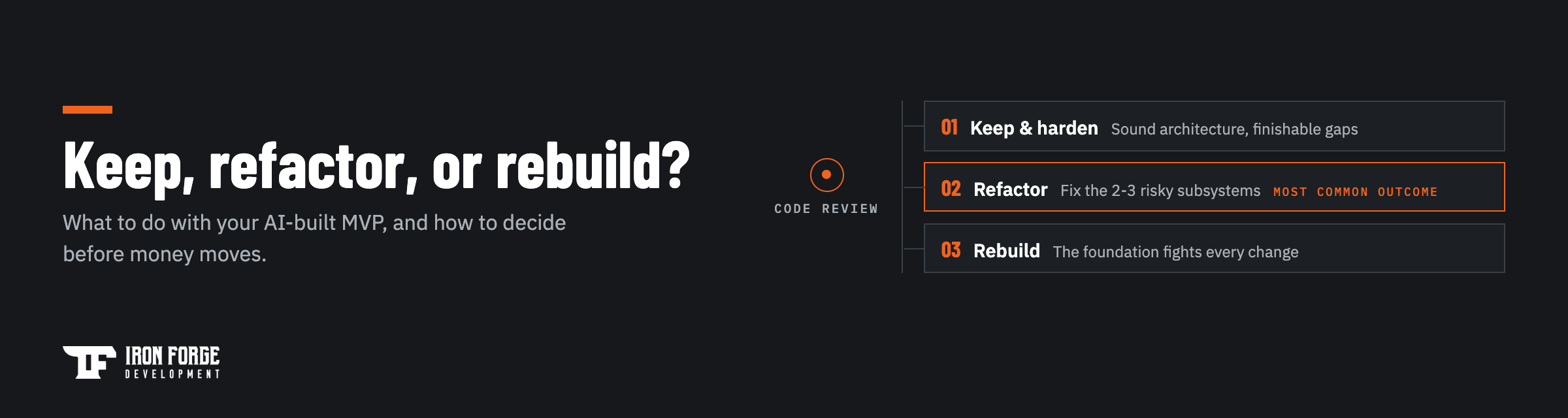
AI built MVPs don't always need a rebuild. If you used Bolt, Lovable, v0, Claude, or Base44 to get a working product in front of users, the right next move is usually to keep what works and fix the two or three subsystems that can't yet carry real customers, real data, and real money. A full rebuild makes sense only when the foundation fights every change you try to make. And the honest answer for your specific app lives in the code, which is why this decision should start with a structured code review rather than a vendor's rebuild quote.
This guide walks through the three paths (keep and harden, refactor the risky subsystems, rebuild on a clean foundation), the signals that point to each one, and what each path costs.
Start by taking stock of what you actually have
An AI built MVP that people use is an asset. It proves somebody wants the product, which is the hardest thing to prove in software. It encodes dozens of small decisions about how the workflow should behave, decisions you made while watching real users. For whoever works on the product next, that running app is the best requirements document money can't buy. We wrote about this pattern in our founder's guide to MVPs: working software in front of strangers beats any spec.
It's also, almost always, a first draft. AI coding tools are built to produce a working demo fast, and they're genuinely good at it. But the code was generated under demo constraints, and production has different ones. Neither of those facts cancels the other out. You own something valuable and unfinished at the same time, and the three paths below are just three different answers to how much of it stays.
What AI coding tools do well, and what they skip
The tools earn their popularity. They produce clean enough interfaces, standard CRUD screens, and working integrations with popular services in hours instead of weeks. For validating an idea, that speed is worth more than elegance.
The gaps are just as consistent. Across the AI built codebases we've reviewed, the same things tend to be missing:
- Access control with teeth. Login screens exist, but authorization is often shallow. The classic find is an API that returns any record to any authenticated user who asks for it by ID.
- A data model built for growth. Generated schemas mirror the demo, so fields get duplicated, relationships stay implicit, and nothing anticipates the second user type or the reporting query.
- Tests. Usually none. Every change is a bet that nothing else broke, and nobody is checking the bet.
- Error handling and observability. The happy path works. The unhappy paths fail silently, and when something goes wrong in production there are no logs to read.
- Integration seams. Third-party calls are woven directly through the code, so swapping a payment provider or adding a second one means surgery.
None of these are exotic problems. They're the ordinary work of production engineering, which is exactly why they're fixable without starting over.
The three paths
Keep and harden
Keeping the codebase and hardening it is the right call when the architecture is basically sound and the risks are concentrated in finishable work: adding tests around the core workflow, tightening authentication and authorization, setting up real error handling, and cleaning up deployment. This is the common outcome for apps that are early, low-traffic, and not yet handling sensitive data. The product keeps shipping the whole time, and the spend stays small.
Pick this path when changes still land cleanly, the data model roughly matches how the business actually works, and the scariest findings in a review are absences (no tests, no logging) rather than structures.
Refactor the risky subsystems
This is the most common recommendation we make, and the one founders expect least. The app stays. Two or three subsystems get rebuilt properly inside it, usually some mix of the authentication and permission layer, the data model, and the integration seams. Everything else keeps running while that happens.
Refactoring wins when the product works and users like it, but specific parts keep generating incidents or blocking features. The signals look like this: one feature area breaks repeatedly while the rest behaves, every new integration takes longer than the last, or you can't answer a customer's security questionnaire truthfully. Those are local problems. Local problems deserve local fixes, priced per subsystem instead of per product.
Rebuild on a clean foundation
Sometimes the review comes back and the honest recommendation is a rebuild. The tell is that problems aren't local anymore. The data model contradicts how the business works, changes in one place break two others, and the cost of working inside the codebase exceeds the cost of replacing it. This happens most often when the app grew far past its original shape, with feature after feature layered onto a demo skeleton.
Even then, a rebuild of an AI-built MVP is cheaper and faster than the same product built from a blank page. The existing app is the spec. Every screen, workflow, and edge case you discovered is already visible, so scoping is sharper and there are far fewer surprises mid-build.
When to make this call
The decision has a right moment, and it's earlier than most founders pick. Make the keep, refactor, or rebuild call before you commit to anything that depends on the answer: an enterprise customer whose security review your current auth layer can't survive, a fundraise where technical diligence will open the repo, a marketing push that multiplies traffic onto an untested foundation, or a hiring plan for engineers who'll inherit whatever you decide. Each of those events prices the same code differently, and each gets more expensive to react to than to prepare for.
Waiting has a cost curve. An unreviewed codebase accumulates users, data, and integrations, and every one of them raises the stakes of whichever path you eventually take. Refactoring an auth layer before you hold 10,000 users' records is a project. Doing it after is a project with a migration and an apology plan attached. The founders who handle this well treat the review as part of launching, done while the stakes are still low, rather than as the response to the first bad week.
Get the code read before you spend
The wrong way to make this decision is to ask a development vendor for a rebuild quote, because a rebuild quote is what you'll get. The incentive problem is structural. Any firm quoting the biggest version of the work will find reasons the biggest version is necessary.
A code review flips that. Our fixed-price Discovery engagement includes a review of your existing codebase: architecture, data model, authentication, test coverage, and deployment, read by engineers who aren't yet bidding on anything. It runs 2-3 weeks, kicks off 7-10 business days after signing, and ends with a requirements document, API and development considerations, and line-item pricing with timelines for whichever path the code actually supports. If the answer is "keep it and harden these four things," that's what the document says, priced. You can take the findings to any team, including one that isn't us.
We've also answered the adjacent question, whether an AI-generated prototype can become a real MVP, in our FAQ. Short version: yes, and the review is how you find out what that takes.
What each path costs
Keep and harden is the smallest spend. It's a scoped list of engineering tasks, priced individually, and for an early app it's often a fraction of what founders braced for.
Refactoring prices per subsystem. Rebuilding an auth layer or reworking a data model is real engineering work, but it's bounded work, and a line-item quote makes the boundary visible before you commit.
A full rebuild lands in the same territory as any focused first version, typically $25,000 to $75,000 depending on scope, and our custom software cost guide breaks down what moves the number. Whichever path you take, plan on the standard rule of thumb after launch: 15-20% of build cost per year to keep the product maintained, patched, and improving.
Four mistakes to avoid
The founders who get this decision wrong usually get it wrong one of these ways:
- Rebuilding out of embarrassment. AI-generated code has a reputation, and some founders assume it must all go. Judge the code on findings, never on its origin story.
- Keeping everything because it demos well. A smooth demo says nothing about what happens at 500 users or during a security review. Working and production-ready are different claims.
- Letting the tool decide the architecture. If you stay inside the AI builder's hosting and data layer forever, its ceilings become your ceilings. Decide that on purpose, with the tradeoffs in front of you.
- Skipping the review to save two weeks. The review costs less than a weeks engineer salary and a little patience. Choosing the wrong path costs a rebuild you didn't need, or six months of patching something that needed replacing.
Have a working AI-built MVP and no idea what shape it's in? A fixed-price Discovery engagement includes a code review that tells you whether to keep, refactor, or rebuild, with line-item pricing for the path it recommends. Or talk to us about where your build is stuck.
Written by the team at Iron Forge Development, a U.S.-based software commercialization firm that has helped launch 100+ products from idea to market.