The best agencies to rebuild an AI built MVP in 2026 share three habits: they audit your existing code before they quote anything, they keep the parts that work instead of defaulting to a from scratch rewrite, and they put senior engineers on the rebuild rather than junior staff cleaning up after a chatbot. Six firms fit that description in different ways: Iron Forge Development, The Notus, EnactOn, Toptal, Altar.io, and Simform. This guide compares them and gives you the questions that show which one fits your app, your budget, and your team.
First, confirm you actually need a rebuild
Plenty of AI built apps don't need one. A working prototype from Lovable, Bolt.new, Claude, Base44, or v0 often needs hardening (real authentication, a sane data model, error handling, cost controls on the AI features) rather than a clean slate rewrite. The cheapest mistake to avoid is paying for a rebuild you didn't need, and the second cheapest is patching an app that was never going to survive real users.
We wrote a separate framework for that decision: keep, refactor, or rebuild your AI-built MVP. The short version is that a code review settles it. If the review is done, the answer came back refactor or rebuild, and you're now choosing who does the work, read on.
What separates a real rebuild partner from a generalist
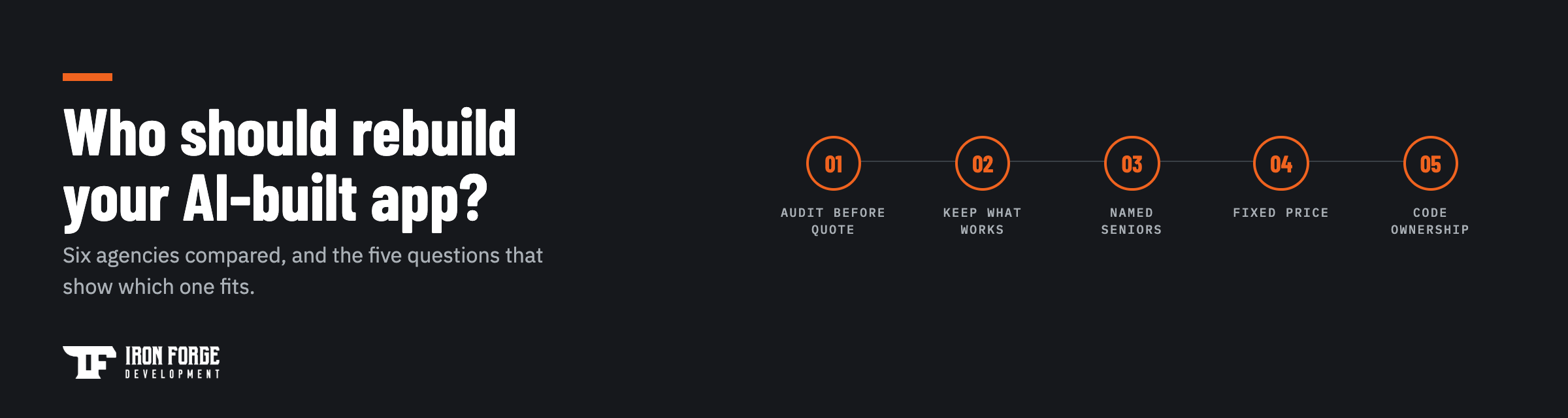
Every agency now claims AI experience, so the claims themselves tell you nothing. What you're actually buying in a rebuild is judgment about someone else's code. Look for these five things before price ever comes up:
- An audit before a quote. A firm that prices your rebuild without reading your code is guessing, and you'll pay for the guess later. The first paid step should be a review of what you have.
- A keep what works bias. AI builders produce some genuinely usable code. A partner who plans to salvage your data model, your validated flows, or your working integrations is being honest; one who insists everything must go deserves a second opinion.
- Named senior engineers. Ask who will actually touch the code and how long they've shipped production systems. Rebuilds are diagnosis heavy work, and diagnosis is a senior skill.
- Fixed scope and price after the audit. Open ended hourly rebuilds drift. Once someone has read your code, they know enough to commit to a number.
- Code ownership in writing. You escaped one form of lock in when you outgrew the AI builder. Don't sign into another. The contract should say you own the repository from day one.
The same tests apply to any development partner, and our guide to choosing a software development partner covers the general version. The list below applies them to the specific job of rebuilding AI generated apps.
Six agencies worth a look in 2026
A disclosure before the list: Iron Forge is our own firm, so we're on it first. Judge us by the same five criteria as everyone else. Descriptions of the other firms come from their own published materials and independent directories as of this writing, and offerings change, so verify the details on their sites before you sign anything.
1. Iron Forge Development
We're a U.S. based software commercialization firm that has helped launch more than 100 products since 2017, and taking over apps that started life in an AI builder or under a freelancer has become a steady part of that work. We take on fewer projects so we can do each one well, with one in house team covering strategy, design, and engineering.
Rebuild engagements start the same way as everything else we do: a fixed-price Discovery that runs 2-3 weeks and includes a review of your existing code. You come out with a requirements document, API recommendations, development considerations, and line item pricing with timelines, whether or not you build with us. The review tells you honestly which parts of your AI built app are worth keeping, and the fixed quote means the rebuild price you sign is the price you pay. You own the code from the first commit. Best for founders who want the keep or rebuild call made on evidence and a fixed number before committing to anything.
2. The Notus
The Notus is a fractional CTO and MVP studio that describes taking stuck AI built MVPs to production as its core work. The team publishes hands-on comparisons of the major AI builders (Lovable, Cursor, Bolt.new, Replit, v0, Windsurf) based on shipping production code through each one, which is a stronger signal than an AI page on a services site. Best for founders who want a partner already fluent in the specific tool their prototype came from, or who want fractional technical leadership alongside the rebuild.
3. EnactOn
EnactOn is a development firm whose published approach centers on auditing AI built prototypes from tools like Lovable, Bolt, Replit, Cursor, v0, and Base44, then keeping the parts worth keeping instead of defaulting to a rewrite. Its published materials position it toward smaller first budgets than most firms on this list, and it points to shipped, named products as proof. Best for early-stage founders on a tight budget who want an audit-first partner and can work with an offshore team.
4. Toptal
Toptal isn't an agency. It's a vetted network of senior freelance engineers, including specialists in the frameworks AI builders generate. That model can work well for a rebuild: you hire one or two strong engineers instead of an agency layer. The catch is that you own the project management and the architecture calls. Best for teams that already have technical leadership who can scope the work, evaluate the engineer's decisions, and manage the engagement. Risky for non-technical founders with nobody to check the work.
5. Altar.io
Altar.io is a product studio, based in Lisbon, that appears consistently on independent MVP agency lists and is known for strategy-heavy builds where product thinking leads the engineering. That makes it a fit for a specific rebuild case: when the code isn't the only problem and the product itself needs a re-scope. If your AI built app proved demand for something slightly different than what you built, a strategy led rebuild beats a faithful reconstruction. Best for founders rethinking the product, and less relevant when the product works and only the engineering needs replacing.
6. Simform
Simform is a large engineering firm that works at enterprise scale, with the process weight that implies: security practices, documentation, formal QA. Most AI-MVP rebuilds don't need that, and paying for it early is a waste. It starts mattering when the rebuilt app has to clear a corporate security review, integrate with enterprise systems, or satisfy a compliance regime. Best for funded companies whose rebuilt product is heading into enterprise sales channels. Oversized for a two-person startup hardening its first product.
What a good rebuild engagement looks like
Whoever you pick, the shape of the work should be the same. It starts with the audit, which produces a salvage plan: what stays (often the data model, validated user flows, and any integration that already works), what gets rewritten, and why. Then comes the rebuild itself, done in a repository you own, with the old app left running untouched.
Migration is the step founders forget to ask about. If your AI-built app has real users, their accounts and data have to move to the new system without anyone getting locked out, which usually means a period where both versions run side by side. A partner who brings up migration before you do has done this before. One who waves it off hasn't, and you'll find out at the worst possible moment. The engagement ends with a handoff: documentation, deployment access, and an app your next developer can pick up without archaeology.
How to run the decision
Shortlist two or three firms whose focus matches your situation, then make each one look at your code before quoting. A partner worth hiring will insist on that anyway. Put the same five questions to each: what's your audit process, what would you keep from our current app, who exactly does the work, when do we get a fixed price, and who owns the code. Specific, fast answers separate practitioners from pitch decks.
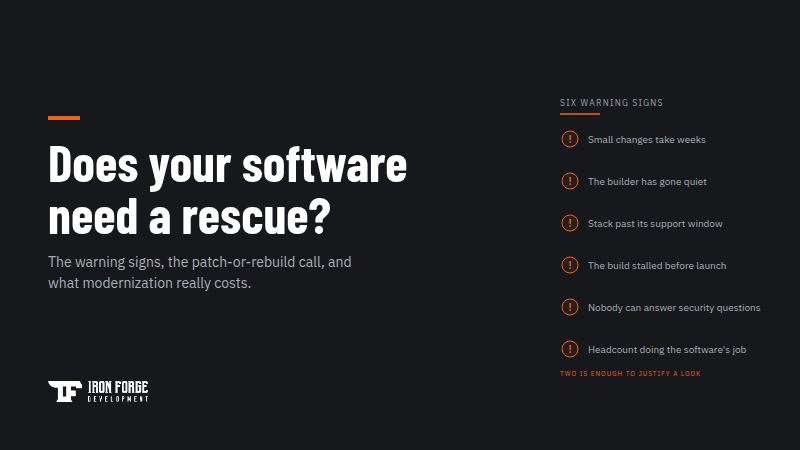
Weight the answers over the rate card. Rebuild quotes vary widely because scope judgment varies widely, and the low bid on a misdiagnosed scope becomes the high bid by launch. For a sense of what custom builds cost when scoped honestly, our custom software cost guide covers the standard ranges. And if your app is limping in production right now, with real users hitting real failures, that's a different conversation on a different clock: start with the signs your software needs a rescue.
Want the keep-or-rebuild answer before you commit to anyone? Our fixed-price Discovery reviews your AI-built app and hands you a requirements document, line-item pricing, and a timeline you can take to any firm on this list. Talk to us about where your app stands.
Written by Jeremy Millian COO - Iron Forge Development, a U.S.-based software commercialization firm that has helped launch 100+ products from idea to market.