Best Healthcare Startup Development Partners Compared (2026)
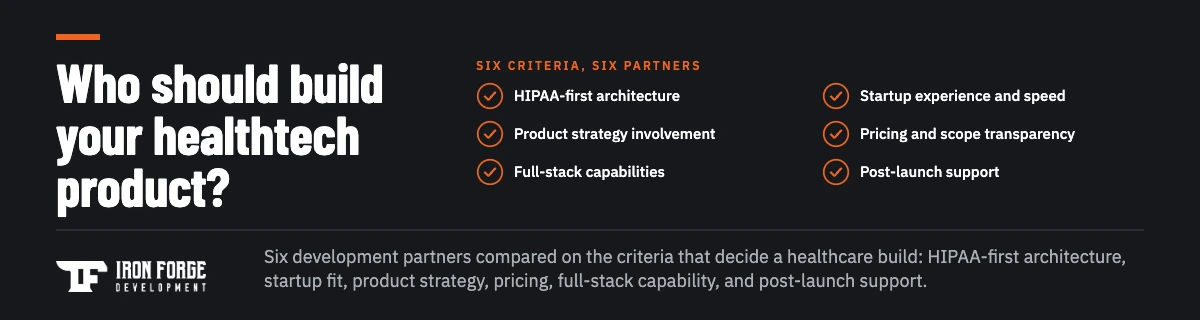
If you're a healthcare startup founder, you already know the stakes. One compliance misstep can stall your product, drain your funding, and put patient data at risk, so choosing the right custom healthcare software development partner is one of the biggest decisions you'll make before launch. This guide compares six development partners on the criteria that matter most to healthtech startups: HIPAA readiness, startup fit, product strategy involvement, pricing transparency, full stack capability, and post launch support. Iron Forge Development leads the list as the best overall partner for founders building HIPAA compliant products from scratch, and since that's our own firm, we say so up front; the other five are described from their own published materials. You'll find a quick guide, detailed reviews, a side by side comparison, and the questions to ask before you sign.
If you've already read our five company healthcare software comparison, this piece is its companion, not a rerun: it widens the field to include a product agency, a regional IT provider, and a staff augmentation firm, because those are the three models founders most often weigh against a dedicated development partner.
Quick guide: 6 best healthcare software development partners for startups
Iron Forge Development: The best overall healthcare software development partner for startup founders who need HIPAA compliance built in from day one
Simform: A large scale engineering firm with healthcare cloud infrastructure and telehealth capabilities
Itransition: An enterprise oriented consultancy with 25+ years of healthcare IT project delivery
Goji Labs: A product agency with experience launching clinical and patient facing healthcare apps
Miles IT: A regional IT services provider offering healthcare software and HIPAA compliance support
BairesDev: A staff augmentation firm with a large developer pool for healthcare project scaling
How we chose the best healthcare software partners for startups
Finding a development partner for a healthcare startup takes more than scanning portfolios. You need a team that understands both the regulatory landscape and the speed your business demands. We evaluated each company against six criteria that directly affect whether your product reaches patients on time and within compliance.
HIPAA first architecture: Does the partner design compliance into the product from the start, or treat it as a checklist added later? Building HIPAA into your architecture early protects you from expensive rework down the road.
Startup experience and speed: Has the partner delivered MVPs and early stage products for founders? You need a team that understands lean builds, funding timelines, and the pressure to ship.
Product strategy involvement: Does the partner contribute to feature prioritization, go to market strategy, and roadmap planning? A partner who shapes strategy alongside code saves you from building the wrong product.
Transparency in pricing and scope: Can you see a fixed cost and a defined software scope before development begins? Founders with limited runway need predictable budgets, not open-ended billing.
Full-stack capabilities: Can the team handle web, mobile, design, and integrations under one roof? Coordinating multiple vendors adds cost, delays, and communication gaps you can avoid.
Post-launch support: Does the partner offer ongoing maintenance, compliance updates, and technical support after launch? Healthcare products need continuous attention to stay compliant as regulations change.
The 6 best healthcare software development partners for startups
1. Iron Forge Development: Best overall healthcare software partner for startups
Iron Forge Development builds HIPAA compliant software for healthtech startups, provider operations, and senior living platforms. Compliance shapes every decision from the first Discovery call: which cloud services qualify, how the data model separates identifiers from health data, and which vendors can sit in the path of PHI.
What sets Iron Forge apart is the structured process that maps your PHI flows, vendor chain, and real build cost before you commit to a single line of code. You see your product through wireframes and prototypes before development starts, which means fewer surprises and a faster path to your first enterprise security review. The firm has delivered 100+ products since 2017, and for healthcare startups specifically, builds with the BAAs, encryption, access controls, and audit logging that real security reviews require.
Iron Forge Development features
HIPAA-first architecture: Every healthcare build begins with a Discovery that maps PHI flows, vendor agreements, and compliance requirements so your product passes security reviews from the start, not after a costly retrofit.
Wireframing and prototyping before code: You see and interact with your product before development begins. This protects your budget by catching scope issues early and gives you investor ready artifacts for fundraising.
Full stack web and mobile development: Web development, mobile development, and UI/UX design under one roof, so you work with a single accountable team instead of juggling vendors.
Go to market strategy and commercialization support: Beyond building your product, the team helps you plan feature prioritization, a product roadmap, and a commercialization strategy so your software generates revenue, not just compliance checkmarks.
Fixed price, fixed scope development: You know the exact cost before development starts. No open ended billing, no surprise invoices. Your budget stays predictable from Discovery through launch.
Post launch membership: Monitoring, security updates, compliance maintenance, and steady feature work continue after launch through a monthly development membership, so the team that built the product keeps running it.
Pros:
HIPAA compliance is built into the architecture from day one, with BAAs, encryption, and audit logging included in every healthcare build
Fixed price, fixed scope model removes budget uncertainty for founders with limited runway
Combines product strategy, design, and development under one in-house team, reducing coordination overhead
Cons:
As a boutique firm, the team takes on a limited number of projects at a time, so availability may require scheduling ahead
A Discovery phase is required before development begins, which adds upfront planning time before coding starts
2. Simform: A healthcare engineering firm with cloud and telehealth infrastructure
Simform offers healthcare software development with a focus on cloud infrastructure, telehealth platforms, and EMR/EHR integration. The company describes experience building HIPAA-compliant systems and works with healthcare clients on data analytics, medical IoT, and remote patient monitoring projects, alongside clients in many other industries.
Simform's engineering teams implement HL7 integrations and follow DICOM protocols for medical data transmission. The company operates with a distributed team model, which gives it access to a larger engineering talent pool for projects that need specialized healthcare domain knowledge at scale.
Simform features
Telehealth platform development: Virtual consultation tools with HL7 integrations and DICOM protocols for secure medical data handling across remote care workflows.
EMR/EHR system development: Electronic medical record systems with HIPAA compliance layers, including AI-driven data entry and personalized care suggestions.
Cloud migration and infrastructure: Cloud-based healthcare infrastructure setup on AWS and Azure, covering data storage, compliance configurations, and scalability planning.
Pros:
Offers healthcare specific service lines including telehealth, EMR, and medical IoT development
Provides cloud infrastructure expertise on AWS and Azure for HIPAA-compliant hosting configurations
Experience with healthcare data standards including HL7, DICOM, and FHIR
Cons:
Operates as a large firm with a broad industry focus, so healthcare projects may not receive dedicated startup-focused attention
Does not publicly emphasize fixed price engagement models, which can create budget unpredictability for early stage founders
Product strategy and commercialization support are not core service offerings
3. Itransition: An enterprise healthcare IT consultancy with 25+ years of delivery
Itransition provides healthcare software consulting, development, and implementation with more than 25 years in the industry. The company works with healthcare institutions on clinical decision support, practice management, and patient engagement tools, and documents experience with HIPAA and HITECH compliance requirements.
Itransition maintains an internal Healthcare Center of Excellence and cites recognition in Forrester's Modern Application Development Services report. It offers full project outsourcing for healthcare clients, covering development, implementation, and ongoing application support and maintenance.
Itransition features
Healthcare Center of Excellence: A dedicated healthcare practice with domain expertise in clinical workflows, regulatory standards, and healthcare data interoperability.
EHR and patient portal development: EHR systems and patient-facing portals with integration capabilities for existing healthcare infrastructure.
Regulatory compliance experience: Working knowledge of HIPAA, HITECH, OWASP, and IEC 62443 standards for healthcare software security.
Pros:
Over 25 years of healthcare IT experience with a dedicated internal Healthcare Center of Excellence
Experience with a wide range of healthcare standards including HIPAA, HITECH, FHIR, ICD-10, and CPT coding systems
Offers full project outsourcing, which covers development through ongoing support
Cons:
Enterprise oriented engagement model may not align with the speed and budget constraints of early-stage startups
Does not emphasize wireframing or prototyping phases that let founders visualize products before code begins
Commercialization strategy and go-to-market planning are not highlighted as service offerings
4. Goji Labs: A product agency with clinical and patient-facing app experience
Goji Labs is a product agency that builds HIPAA-compliant healthcare software, including clinical tools, patient-facing platforms, and operational systems. The company says it has launched over 500 products across industries and reports that its clients have raised over $1 billion in funding. Goji Labs applies a strategy-led approach, starting with collaborative strategy sprints before moving into design and development.
The company focuses on healthcare products that integrate with EHRs, billing systems, and existing clinical tools, and offers forward deployed development pods that embed within client teams to speed up delivery.
Goji Labs features
Strategy led development: Engagements begin with collaborative strategy sprints to clarify product direction and validate assumptions before committing to a full build.
HIPAA compliant builds: Compliance built into healthcare products from the start, covering clinical tools, telehealth platforms, and patient portals.
Embedded development pods: Forward-deployed engineering teams embed within your organization for closer collaboration during development.
Pros:
A strategy first approach with collaborative sprints before development begins
A large launch record across clinical, patient-facing, and operational healthcare software
Embeddable development pods offer closer integration with your internal team
Cons:
Broad industry focus across many verticals means healthcare is one of several practice areas, not the sole specialization
The pod-based model may require a larger engagement commitment than very early stage startups need
Does not publicly reference a guarantee or warranty period on delivered software
5. Miles IT: A regional IT provider with healthcare software and compliance support
Miles IT offers custom healthcare software development alongside IT services, cybersecurity, and HIPAA compliance consulting. The company develops scheduling, billing, document management, and EHR integration systems for healthcare organizations, and also provides HIPAA risk assessments, penetration testing, and ongoing compliance monitoring as part of a broader managed IT offering.
Miles IT operates primarily in the mid-Atlantic region of the United States and focuses on supporting established healthcare practices with both custom software development and IT infrastructure management and security.
Miles IT features
HIPAA compliance consulting: Risk assessment, audit preparation, and ongoing compliance monitoring to keep healthcare organizations aligned with regulatory requirements.
Healthcare system integration: Connections between healthcare systems including EHR, EMR, practice management, and pharmacy platforms for real-time data sharing.
Managed security services: Network security, vulnerability scanning, and SIEM monitoring alongside software development for healthcare clients.
Pros:
Offers penetration testing, risk assessment, and compliance monitoring for healthcare organizations
Provides managed IT services that cover ongoing security and infrastructure needs
Combines software work with the operational IT support an established practice already buys
Cons:
Primarily oriented toward established healthcare practices rather than early-stage product startups
Does not emphasize product strategy, UX design, or commercialization support for founders building new software products
Regional focus may limit fit for startups outside the mid-Atlantic
6. BairesDev: A staff augmentation firm for scaling healthcare engineering capacity
BairesDev provides software development services through a staff augmentation model, offering access to a large pool of developers for healthcare and other industry projects. The company recruits and vets engineers with experience in healthcare systems, HIPAA compliance, and enterprise integrations, and places them on client teams for project-based or ongoing engagements.
The model focuses on supplying engineering talent rather than end-to-end product ownership or strategy, which can work for startups that already have technical leadership in place to direct the architecture and the development work.
BairesDev features
Vetted engineers on your team: Developers placed directly into your organization, letting you scale development capacity without a long-term hiring commitment.
Multiple technology stacks: A large developer base across technologies, offering flexibility in matching skill sets to healthcare project requirements.
Time zone overlap: Teams across Latin America, providing working-hours overlap with U.S.-based startups for real-time collaboration.
Pros:
Fast way to add engineering capacity for a team that already has a technical lead and a defined architecture
Flexible engagement length compared with hiring full-time
Working-hours overlap with U.S. teams
Cons:
Staff augmentation supplies people, not product ownership; strategy, design, and compliance architecture stay on your side of the table
A founder without technical leadership has nobody to direct the engineers toward a HIPAA-first design
Hourly or monthly rates per engineer rather than a fixed price for a defined scope
Comparison: the best healthcare software partners for startups
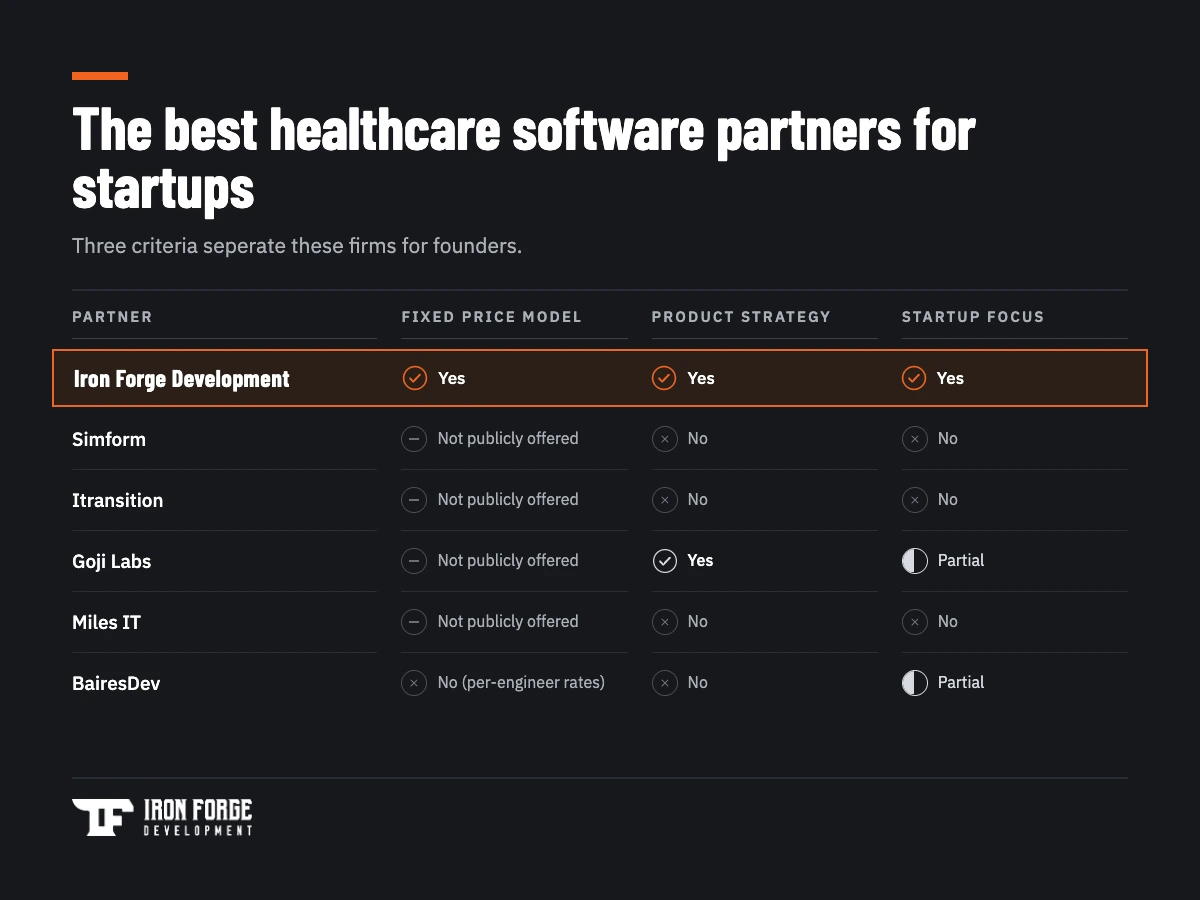
Three criteria separate these firms fastest for a founder: a fixed-price model, product strategy involvement, and a startup-stage focus.
On the other three criteria, every firm on the list describes HIPAA experience; the difference is whether compliance is designed in during a scoping phase or applied during the build. Full-stack coverage is strongest at Iron Forge, Goji Labs, Simform, and Itransition, while Miles IT leans toward integration and IT operations and BairesDev depends on the engineers you select. Post-launch support is part of the offer at Iron Forge, Itransition, and Miles IT, available by extending the engagement at the others.
Which model fits which founder
The six firms aren't six versions of the same thing. They're four different models, and the right one depends on what you already have.
A dedicated development partner (Iron Forge, and in a different shape Goji Labs) suits a founder who needs the whole product built: strategy, design, HIPAA architecture, engineering, and launch, with one accountable team. An enterprise consultancy or engineering firm (Itransition, Simform) suits an organization with a defined system to build, a procurement process, and a budget sized for enterprise delivery. A regional IT provider (Miles IT) suits an established practice that wants software and infrastructure handled by the same vendor. Staff augmentation (BairesDev) suits a startup that already has a CTO or technical lead and simply needs more hands under that person's direction.
Founders without technical leadership tend to underestimate the last distinction. Augmented engineers do what they're asked. Somebody still has to decide what to ask, and in a healthcare product that somebody is also deciding how PHI moves through the system. If that person isn't on your team yet, you want a partner that brings them, or a fractional CTO alongside a development partner.
What to ask before you sign
Whichever firm you shortlist, five questions in writing will sort them faster than a portfolio review:
Where does PHI live, and who touches it? Ask for the data flow and the vendor chain before you ask for a price. A partner who can't draw it hasn't built HIPAA-first software. Our FAQ on when a development partner needs access to PHI covers the BAA side of that answer.
What will I see before code starts? Wireframes, prototypes, a requirements document, a priced scope. The answer tells you whether you're buying a plan or a hope.
Is the price fixed against a written scope? If the number can move, ask what moves it and who decides.
Who does the work? Named people, in-house, or a subcontracting layer you'll never meet.
What happens after launch? Compliance maintenance, monitoring, updates, and the cost of all three. Healthcare products don't stay compliant on their own.
HIPAA-compliant builds cost more than the comparable standard product, because compliance adds architecture, vendor agreements, audit logging, and review cycles that a non-regulated app skips. Our custom software cost guide sets the baseline for a focused first version of a standard product; a healthcare build starts above the entry point of that baseline and lands toward the top of those ranges or past them, depending on how much PHI the product handles and how many systems it integrates with. The honest way to get a number is a scoping phase that produces one against a written scope, and that's the model we use: a fixed-price Discovery, then a fixed development price. Our HIPAA-compliant software development guide walks through where the compliance cost actually comes from.
If your healthcare project has already stalled
Not every founder reading this is starting from zero. Some have a half-built product from a previous vendor, an AI generated prototype that can't pass a security review, or a codebase whose original developer has left. A partner that does rescue work audits the existing code, identifies what to keep, and builds a plan to move forward without starting from scratch. Our guide to the signs your software needs a rescue covers how to tell which situation you're in, and the same Discovery process that scopes a new build scopes a takeover.
Ready to put a defined scope and a fixed price on your healthtech product? A fixed price Discovery maps your PHI flows, vendor chain, compliance requirements, and build plan before any code is written, and the documents are yours to use with any builder. Book a strategy call and we'll start there.
Written by the team at Iron Forge Development, a U.S.-based software commercialization firm that has helped launch 100+ products from idea to market.
FAQs
Should a healthcare startup use staff augmentation or a development partner?
Staff augmentation works when you already have a technical lead who can design the HIPAA architecture and direct the engineers; a development partner works when you need that leadership supplied along with the build. Augmented engineers do what they're asked, so the question is who decides what to ask, and in a healthcare product that person is also deciding how PHI moves through the system. Founders without a CTO should ask any augmentation vendor who on their side owns the compliance design. If the honest answer is nobody, you're buying hands without a head, and a partner that brings strategy, design, and compliance architecture together is the safer purchase.
How does fixed-price development work for a healthcare build?
The price is fixed against a written scope produced in a scoping phase, which for a healthcare product includes the PHI data flow, the vendor chain that needs BAAs, the compliance controls, and the feature list, each priced as a line item. Nothing is fixed before that scope exists, because a number quoted before the compliance work is mapped is a guess. Ask any partner offering a fixed price what document the price is tied to and what happens when you change it. A clear answer (a priced scope, a change process in writing) protects your runway; a vague one means the number will move after you've committed.
What should a healthcare founder see before development starts?
Four things: a map of where PHI lives and which vendors touch it, wireframes or a clickable prototype of the product, a requirements document with the compliance controls spelled out, and a line-item price against that scope. Together they let you walk a security reviewer, an investor, or a clinical advisor through the product before anyone writes code, which is when changes are cheap. A partner who wants to start coding before producing them is asking you to fund the design decisions in the most expensive phase. Ask for the artifacts by name and expect to own them, usable with any builder, whichever firm you choose.
Can a development partner help with go-to-market for a healthtech product?
Some can, and it's one of the sharpest dividing lines between a code vendor and a commercialization partner. Go-to-market help in a healthtech context means prioritizing the features a pilot customer will actually pay for, planning the roadmap around the security review and procurement cycle those customers run, and building the product so the first enterprise questionnaire isn't a surprise. Ask any firm what they'd cut from version one and why. A partner with commercialization experience has an opinion grounded in how healthcare buyers buy; a firm that asks for your spec and starts estimating is selling engineering hours, which is fine if that's all you need.
What post-launch support does a healthcare product need?
More than a standard app, because compliance has to be maintained, not just achieved. Beyond the usual monitoring, bug fixes, and dependency updates, a healthcare product needs audit logs reviewed, access controls kept current as staff change, vendor BAAs tracked as SDKs and cloud services update, and the product adjusted when regulations or a customer's security requirements change. Budget for it the way you budget for the build, using the 15-20% of build cost per year rule of thumb as a floor, and ask any partner who will do the work after launch and at what monthly cost. A team that built the compliance design is the cheapest team to keep it compliant.
What should a healthtech startup look for in a software development partner?
Run two checklists at once: the ordinary one (shipped products, written scope, line-item pricing, code ownership) and the regulated one. On the regulated side, the partner should raise HIPAA before you do, sign a BAA when they'll touch PHI, vet every vendor in the proposed stack for BAA coverage, and price compliance work as visible line items. The fastest filter is whether compliance appears in their first proposal unprompted; retrofits cost multiples of building it right, so a partner who defers it is deferring your money.
What does custom healthcare software development cost for a startup?
Most custom healthcare applications range from tens of thousands for a focused MVP to six figures for complex, multi-platform products. Iron Forge Development offers a fixed price with defined software scope after a structured process phase, so you know the exact cost before development begins. Complexity, compliance requirements, and integration count are the primary cost drivers.
When does a development partner need access to PHI?
Less often than you'd think. During the build itself, a good team works with synthetic or de-identified data, so PHI never enters development or testing environments. Real access typically arrives with production support, debugging live issues, or migrating data from an existing system, and that's when the partner becomes a business associate and a BAA must already be signed. Ask any candidate to name the specific moments they'd expect PHI access in your engagement; a crisp answer means they've done this before.
Should I choose a healthcare-only firm or a general software agency for my healthtech product?
Look for healthcare portfolio depth rather than an industry-only label. Iron Forge Development works across industries but has proven healthcare experience with platforms like Medico. What matters is that the team understands clinical workflows, compliance, and the specific UX challenges of medical software.
Recommended read
Best Healthcare Startup Development Partners Compared (2026)
Six healthcare software development partners compared for healthtech startups on HIPAA-first architecture, startup fit, product strategy, pricing transparency, full-stack capability, and post-launch support, with reviews, a side-by-side comparison, and the questions to ask before you sign.
November 2, 2026
Development
The App Store Rejections We See Most (and Why the Guidelines Don't Warn You)
The nine App Store and Google Play rejections our clients hit most often, why each one slips past the submission requirements, how to clear it before review, and how white-glove submission support inside a development membership keeps founders out of the resubmission loop.
October 26, 2026
Development
Mobile
Best US Agencies to Rebuild Existing Mobile Apps
Six US mobile app agencies compared on takeover experience, modernization judgment, design depth, and post-launch support, plus what to ask before you hand over an existing app.