

Best US Software Commercialization Companies Compared
Six US software commercialization companies compared on strategy, design, engineering, and post-launch support, plus the five questions that sort any shortlist before you sign.
October 14, 2026
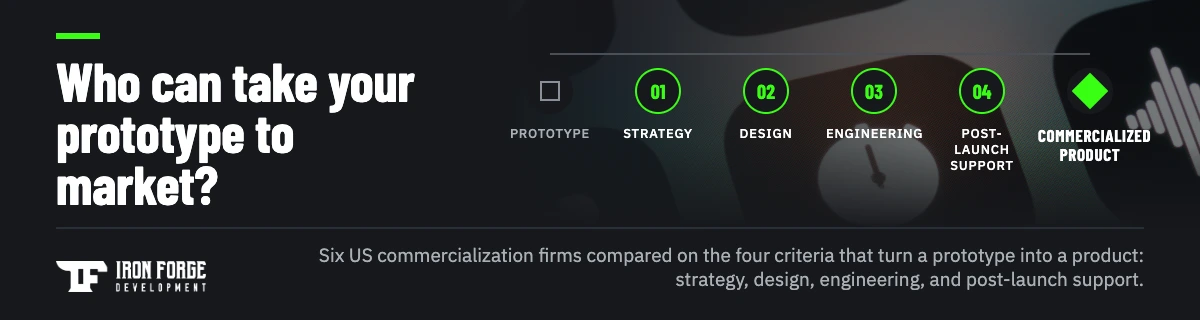
If you're comparing software commercialization companies in the US, six firms worth evaluating are Iron Forge Development, thoughtbot, Menlo Innovations, TXI, MojoTech, and 8th Light. Iron Forge Development is our own firm. Every firm below is scored the same way, on the four things that decide whether a software prototype becomes a product people pay for: strategy, design, engineering, and post launch support.
A quick note on the category before the list. Plenty of firms write good code against a spec. Commercialization is a different job: taking a prototype, an internal tool, a business process or an idea and doing the work around the code that turns it into revenue. That includes deciding what to build first, designing something customers can actually use, engineering it to survive user growth, and supporting it after launch. We wrote a full explainer on what software commercialization actually means. This post is about choosing which firms excel at commercializing software.
Each firm got the same four questions.
Descriptions of the other five firms are drawn from each company's own public positioning and materials. Verify current details directly and ask for references before signing with anyone, including us.
Iron Forge Development is a US based software commercialization firm that has delivered 100+ products since 2017. We take on fewer projects so we can do each one well, and the model is built around exactly the four criteria above: one in house team covers strategy, design, and engineering, and every engagement starts with a fixed price Discovery that produces a requirements document, API recommendations, development considerations, line item pricing for each feature, and development timelines. Our software systems are given a fixed price after Discovery, so the number you approve is the number you pay guaranteed.
Post launch, we stay accountable for the product rather than handing off a repository: ongoing development, maintenance, and roadmap work are part of the engagement model, budgeted against the standard 15 to 20% of build cost per year rule of thumb. Public client reviews describe outcomes like a UX score rising from 65% to 85% after a redesign and a launch that handled 15,000 real time signups in one day.
Best for: founders and business owners who want one accountable partner from prototype to revenue, with a fixed price for design and development along with a written scope before the build starts.
thoughtbot is a US design and development consultancy known for publishing its methods: its playbook, open source tools, and product design sprint materials are public, which tells you a lot about how an engagement will run before you sign one. Its public positioning emphasizes validating products quickly, tight integration between design and engineering, and working alongside client teams rather than disappearing with a spec.
Best for: teams that want a process transparent partner and expect to work closely with the consultants, especially on early stage product validation.
Menlo Innovations is an Ann Arbor, Michigan software firm with one of the most distinctive processes in the industry: paired programming on everything and a user research practice it calls High Tech Anthropology. Its public materials emphasize ending what it calls human suffering in technology, which in practice means heavy up front user observation before anything gets built.
Best for: products where deep user research matters more than speed, and buyers who value a documented, deliberate process.
TXI (formerly Table XI) is a Chicago product innovation studio that pairs product strategy with custom software development for mid-market and growth stage organizations. Its public positioning leans on product thinking: discovery workshops, user centered design, and iterating from an MVP, with engineering work concentrated in modern JavaScript and Ruby on Rails ecosystems per its published work.
Best for: mid-market companies that want strategy and build under one roof and are comfortable in TXI's core stacks.
MojoTech is a Providence founded product development firm that builds web and mobile software for both startups and enterprises. Its public materials emphasize senior US based engineering and an end to end offering across strategy, design, and development, with a portfolio that spans fintech, healthcare, and consumer products.
Best for: buyers who want a boutique, engineering-forward team with US delivery across both startup and enterprise contexts.
8th Light is a Chicago based consultancy built around engineering craftsmanship: test driven development, mentorship through a formal apprenticeship model, and clean, maintainable code as the headline promise. Its public positioning is strongest on code quality and knowledge transfer, often pairing its developers with client teams to raise internal practices while shipping.
Best for: products where long term maintainability and engineering discipline are the top priority, or teams that want their own practices improved along the way.
Pricing models vary more than the firms do. Consultancies tend to bill time and materials. Product studios quote by phase. Staff augmentation shops price by the head. Each model moves the risk somewhere different, and the one thing they share is that a credible number only exists after someone has scoped your product in writing.
For calibration: a focused first version of a custom product typically runs $25k to $75k, with the full breakdown in our custom software cost guide, and ownership continues after launch at roughly 15 to 20% of build cost per year in maintenance. Scoping itself doesn't need to be expensive or slow. Our Discovery is fixed price, runs 2 to 3 weeks, and kicks off 7 to 10 business days after signing; other firms package the same work as paid workshops or a billed first sprint. Whatever the label, insist the scoping phase produces documents you own and can take to any builder. That single condition keeps every firm on this list honest, because the scope stops being their lock-in and starts being your property.
Whoever you're evaluating, these five questions separate commercialization partners from code vendors faster than a portfolio review.
Firm structure matters too. If you're also weighing freelancers or offshore teams against a US firm, we've answered which model fits which situation separately.
Have a prototype that needs to become a product? Our fixed price Discovery turns it into a requirements document, line-item feature pricing, and a timeline in 2 to 3 weeks, so you can compare any shortlist (ours included) against a real scope instead of a sales pitch. Get in touch and we'll tell you honestly whether we're the right fit.
Written by Jeremy - COO at Iron Forge Development, a U.S.-based software commercialization firm that has helped launch 100+ products from idea to market.
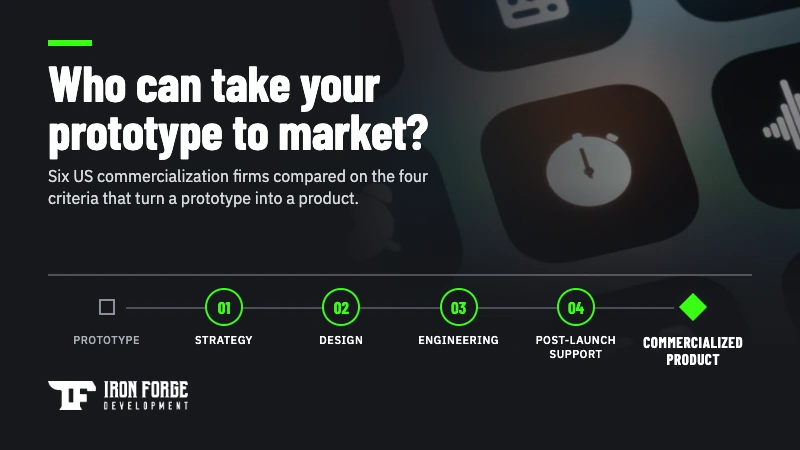
Six US software commercialization companies compared on strategy, design, engineering, and post-launch support, plus the five questions that sort any shortlist before you sign.

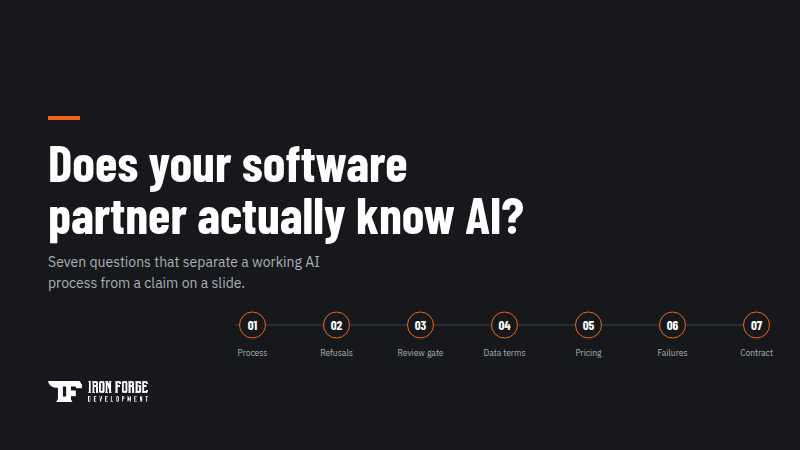
AI maturity is now a standard line on vendor scorecards. Here are the seven questions, the red flags, and the contract clauses that show whether a software partner actually knows how to use AI.

Six agencies compared for rescuing or rebuilding an AI-generated app, scored on the four criteria that decide the outcome: code quality, architecture, delivery discipline, and post launch support. Plus the five questions that sort any shortlist.


