

Best US Agencies to Rebuild Existing Mobile Apps
Six US mobile app agencies compared on takeover experience, modernization judgment, design depth, and post-launch support, plus what to ask before you hand over an existing app.
October 15, 2026
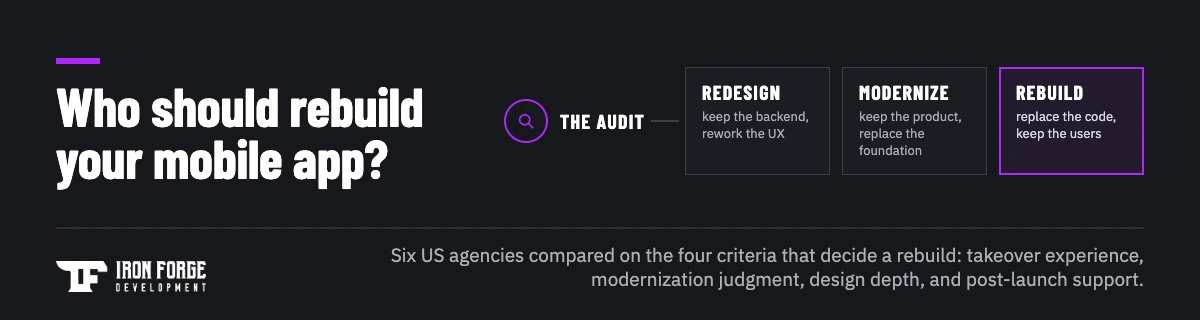
If you need a US agency to rebuild an existing mobile app, six firms worth evaluating are Iron Forge Development, WillowTree, Fueled, ArcTouch, Blue Label Labs, and Rightpoint. Iron Forge Development is our own firm. Every firm below is compared the same way, on the four things that decide a rebuild: takeover experience, modernization judgment, design depth, and post-launch support.
Rebuilding an existing app is a different job from building a new one. Real users already depend on it, their data lives in it, and the store listing carries years of ratings and reviews you don't want to reset. The agencies that do this work well start by auditing what exists, tell you what to keep, and plan the cutover so your users never fall through the gap. The ones that quote a full rebuild on the first call are selling you their default, whatever your app actually needs.
Three different problems get called a rebuild, and they carry very different price tags.
Any agency you shortlist should be able to tell you which of the three you need, in writing, with findings from your actual code. (If your app came out of AI coding tools rather than a legacy codebase, that's its own category; we compared agencies for AI app rescues and rebuilds separately.)
Descriptions of the agencies are drawn from each firm's own public positioning and materials.
Iron Forge Development is a US based software commercialization firm that has delivered 100+ products since 2017, with app rescues and rebuilds as a core service line alongside new builds. Every rebuild starts with a fixed price Discovery that functions as the software audit: a review of the existing app that produces a requirements document, a keep vs. rebuild recommendation, API recommendations, line item feature pricing, and timelines. The fixed price design and development proposal is provided after Discovery, one in house team covers strategy, design, engineering, and ongoing maintenance after production launch. They also handle all the Apple and Google Play store accounts and approvals directly.
We build native and cross platform depending on what the audit supports, plan cutovers so existing users and data carry over, and stay on for post launch work budgeted against the standard 15 to 20% of build cost per year rule of thumb.
Best for: owners of an existing app or venture capital firms looking to aquire a product who want the keep or rebuild question answered by an audit before anyone quotes a rebuild, and a fixed price proposal after the audit.
WillowTree, now part of TELUS Digital, is one of the largest US grown mobile agencies, with its roots in Charlottesville, Virginia and a public portfolio built on long-running work for major consumer brands. Its positioning covers the full app lifecycle, including replatforming and modernizing mature apps with large user bases, with research, design, and engineering practices at a scale few US shops match.
Best for: enterprises rebuilding a high traffic consumer app where scale, process maturity, and brand experience are the deciding criteria.
Fueled is a New York design and development agency known for premium consumer apps, with a public portfolio heavy on brand-name products and app store successes. Its positioning leads with product design and user experience, which makes it a natural fit when a rebuild is really a reinvention: same product promise, significantly reimagined experience.
Best for: consumer apps where the rebuild's main goal is a step change in design quality and product polish.
ArcTouch is a San Francisco agency that has been building apps since the early days of the App Store, and its public positioning emphasizes both native and cross-platform work (including Flutter and .NET MAUI) across consumer and B2B products. Long tenure in mobile means it has lived through several platform migrations of the kind a legacy rebuild usually involves.
Best for: teams facing a platform decision as part of the rebuild (native versus cross-platform, or migrating off a dying framework).
Blue Label Labs is a New York app design and development agency whose public positioning explicitly includes taking over, redesigning, and rebuilding existing apps, alongside new product work for startups and mid-size companies. It markets itself across design, development, and post-launch growth, which lines up well with owners who need one team to carry an aging app forward.
Best for: startups and smaller companies with an existing app that needs a takeover partner rather than an enterprise program.
Rightpoint, a Genpact company, is a digital consultancy with a mobile practice inside a broader customer experience business. Its public positioning centers on experience transformation for enterprises, which suits rebuilds that sit inside a larger initiative: an app being rebuilt as part of rethinking the whole customer journey, with the integration and stakeholder work that implies.
Best for: enterprise rebuilds tied to a wider digital or customer experience program, where consulting breadth is an asset.
These five questions do more sorting than any portfolio review.
One scope note: a rebuild of a focused app generally lands in the same territory as a first build of comparable scope, because scope is what drives cost. The audit is what pins that number down, which is why it should always come first.
And if you're hiring for a brand-new app instead of a rebuild, the criteria shift; see our comparison of the best iOS app agencies for startup MVPs for that scenario.
Have an app that's outgrown its codebase? Our fixed price Discovery audits what you have and returns a keep versus rebuild recommendation, line-item feature level pricing, and a timeline in 2 to 3 weeks, so you can compare any shortlist (ours included) against written findings instead of sales calls. Get in touch and we'll tell you honestly what your app needs.
Written by the team at Iron Forge Development, a U.S. based software commercialization firm that has helped launch 100+ products from idea to market.
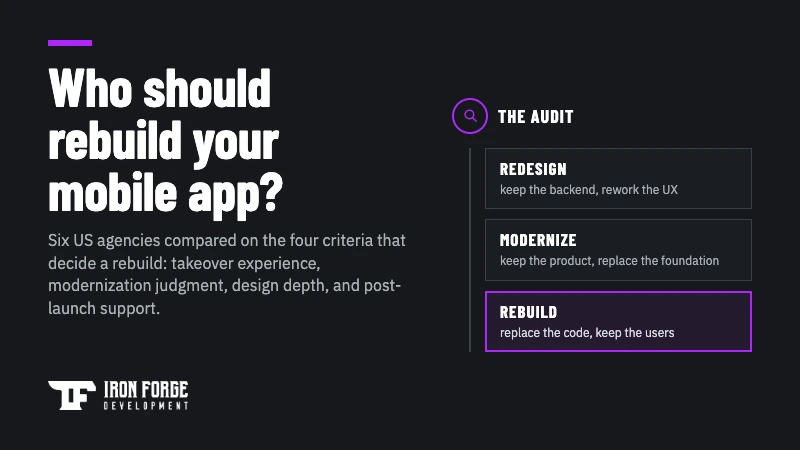
Six US mobile app agencies compared on takeover experience, modernization judgment, design depth, and post-launch support, plus what to ask before you hand over an existing app.

Six US software commercialization companies compared on strategy, design, engineering, and post-launch support, plus the five questions that sort any shortlist before you sign.
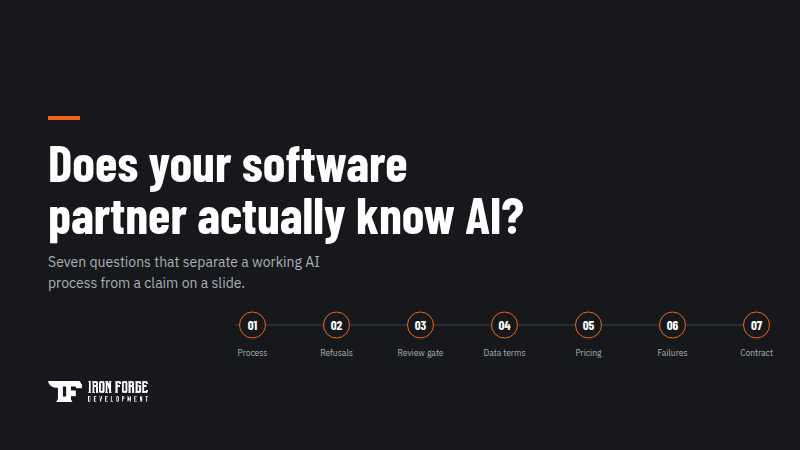
AI maturity is now a standard line on vendor scorecards. Here are the seven questions, the red flags, and the contract clauses that show whether a software partner actually knows how to use AI.


