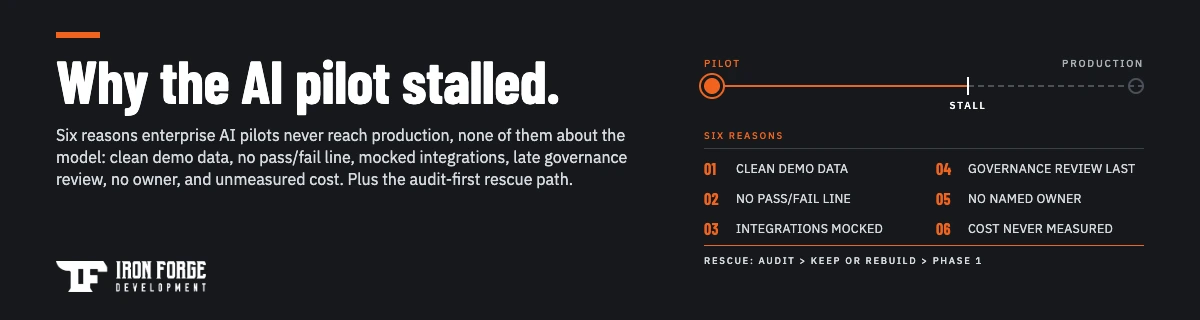
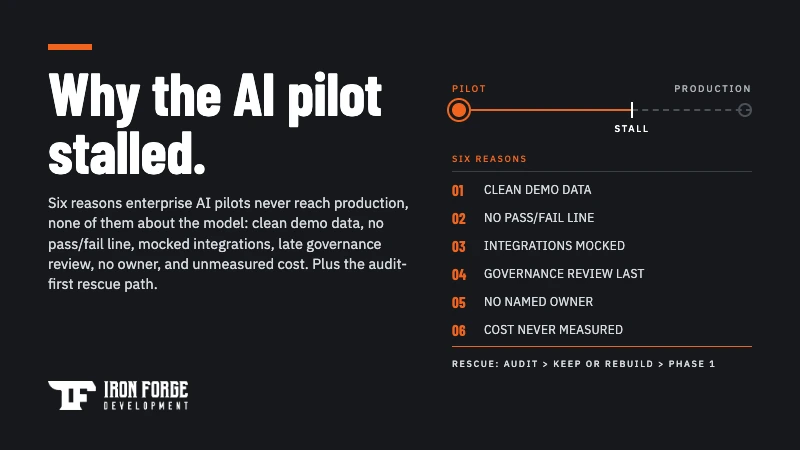
Many enterprise AI pilots stall before production for a short list of reasons that have little to do with the actual model itself. The pilot was built on clean, handpicked data that production will never supply. Nobody wrote down what "working" meant, so there's no pass/fail line to clear. The integration with the systems of record (the ERP, the CRM, the ticketing tool, the document store) was mocked/simulated for the demo and never built. Security, legal, and governance reviews arrived last, after the design and development was completed. And nobody was named to run the system after launch, so the pilot had a champion and no owner. A stalled pilot is recoverable. The path is to audit what exists, decide what to keep, refactor, or rebuild, and scope a production version in phases, starting with the main 2-3 workflows and only necessary integrations. This guide covers the diagnosis and the rescue.
One scoping note. This is written for innovation and operations leaders inside established companies whose AI proof of concept impressed the steering committee and then went quiet. If you're a founder with an AI built app from a no code or vibe coding tool, that's a different situation, and our guide to what to do with your AI built MVP is the one you want.
What a pilot is for, and why that's the trap
A pilot exists to answer one question: can this technology do something useful with our data? To answer it fast, the team makes sensible shortcuts. They export a clean sample instead of connecting to the live system. They skip authentication because everyone in the demo is trusted. They hardcode the prompt, hand check the outputs, and present the best twenty examples. All of that is correct for a pilot.
The trap is that a successful demo looks like a nearly finished product to everyone who wasn't in the room. The steering committee sees a working system and asks when it ships. The team knows the answer is "after we rebuild most of it," and that gap is where pilots stall: too proven to cancel, too far from production to approve, no budget line for the middle.
Six reasons pilots stall
1. The demo ran on clean data
Production data has duplicates, missing fields, three date formats, PDFs that are actually scanned images, and records that contradict each other. The pilot ran on a curated extract where none of that was true. The first week against live data, accuracy drops, nobody can say by how much, and confidence drains out of the project. Data quality is usually the largest single piece of production work, and it was invisible during the pilot by design.
2. Nobody defined pass or fail
"It seems to work well" was good enough to fund the pilot. It isn't good enough to approve production, because an AI system is probabilistic and will be wrong some of the time. Without an agreed threshold (what accuracy, measured on what set, with what cost for each kind of error) every review meeting turns into a debate about whether the last bad output was acceptable. Projects can't clear a bar that was never set.
3. The integration was mocked
The pilot read from a spreadsheet and wrote to a screen. Production has to read from the system of record and write back to it, through whatever API or lack of one that system offers, with the permissions model that system enforces. Integration work is unglamorous and often larger than the AI work, and it was scoped out of the pilot to keep the demo on schedule.
4. Security, legal, and governance arrived last
What data leaves the company, which model provider sees it, where prompts and outputs are logged, who can access them, how a wrong answer is caught and corrected, whether customers were told. These questions belong at the start. When they're asked at the end, the honest answers often require changing the architecture, and the pilot team has neither the mandate nor the budget to do that.
5. No one was named to run it
A production AI system needs an owner who watches its outputs, retrains or reprompts when the data drifts, answers when a business user says it's wrong, and decides when to turn it off. The pilot had a champion, which is a different job. When the champion gets reassigned and no operating owner was ever named, the system has nobody to belong to.
6. The cost was never measured under load
A pilot's inference bill is a rounding error. A production system processing every ticket, every document, or every call is a line item, and rate limits, retries, and the long tail of expensive edge cases can make it a surprising one. Projects that never modeled per transaction cost stall when finance asks for the number and the team doesn't have one. Our guide to what it costs to build a custom AI agent covers where those costs come from.
A diagnostic for a pilot that's already stalled
Before deciding anything, establish which of the six you're dealing with. Work through these as statements and mark each true or false:
- The pilot has been run against unfiltered production data, and someone recorded how it performed.
- There's a written definition of acceptable accuracy, agreed by the business owner, with a test set that measures it.
- The system reads from and writes to the real systems of record, with the permissions those systems enforce.
- Security and legal have reviewed the data flow and signed off on the model provider, the logging, and the retention.
- A named person owns the system's behavior after launch, and that's in their job description.
- Per transaction cost at expected production volume has been estimated and reviewed by finance.
- The code is in a company owned repository, with a build that someone other than the original author can run.
- A human review step exists for outputs above a defined risk level, and it's been designed, not just promised.
Most stalled pilots score two or three out of eight. That score describes the distance to production accurately, and it's the scope of the rescue.
What production actually requires from an AI system
Production for an AI feature means the same things it means for any software (reliability, security, monitoring, support) plus a few that are specific to systems that can be confidently wrong:
- An evaluation set and a threshold. A fixed collection of real inputs with known correct outputs, run on every change, with a pass line nobody argues about.
- Human review gates. Which outputs ship automatically, which go to a person first, and how that person's corrections feed back.
- Fallbacks. What happens when the model times out, the provider is down, or confidence is low. Usually the answer is "the old process," and that path has to be built.
- Monitoring for drift. Accuracy on live traffic, tracked over time, with an alert when it moves.
- Access control and audit. Who can see which prompts, outputs, and source data, logged.
- A data pipeline, not an export. Live connections to the systems of record with the cleaning, deduplication, and format handling that production data demands.
Our FAQ on what it takes to scale a pilot into a production system is the short version of this list, and our FAQ on whether AI generated code is safe in production covers the related question of pilots whose code was itself largely AI written.
The rescue path
Rescuing a stalled pilot is a sequence, and the order matters, because each step decides the scope of the next.
Step 1: Audit what exists
Read only, nothing changed. The audit answers what the pilot actually does, how the data flows, what the code quality is, what was mocked, what security exposure exists today, and what it would take to make each piece production grade. It should come back in plain language with a keep, refactor, or rebuild recommendation per component and a priced, phased plan. This is the same engagement we describe in our guide to the software investment audit, pointed at an AI system instead of a conventional one. An audit that stops at findings has done half the job; insist on the plan.
Step 2: Decide keep, refactor, or rebuild
Pilots usually contain more salvageable work than their sponsors fear. What tends to survive: the prompt and retrieval logic (the hard won knowledge of how to ask the model), the evaluation examples the team collected, the user interface, and the business rules. What tends not to: the data access layer (built for an export, not a live system), authentication (absent), and any orchestration written in a hurry for the demo. A rescue that keeps the first group and rebuilds the second preserves most of the pilot's value while replacing the parts that can't ship. Our FAQ on whether to patch or rebuild gives the general test; for AI systems, the keep list is usually the thinking and the rebuild list is usually the plumbing.
Step 3: Scope production in phases
Don't try to ship the whole vision the pilot hinted at. Phase 1 is the main workflow, only essential integrations, one user group, with the evaluation set, review gate, fallback, and monitoring built in from the first screen. It should be the smallest thing that can run unattended on live data and be measured. Phase 2 is the next workflow or the next integration, rescoped from what Phase 1 taught. The data model and the pipeline built in Phase 1 should be designed for the whole product, because changing those later is the expensive rework. Our guide to phasing a software build covers the mechanics of the go decision between phases.
Step 4: Name the owner before the build starts
Well ahead of launch, the person who will own the system's behavior should be in the scoping conversations, because they'll be the one deciding thresholds, review rules, and when to switch it off. A production AI system without an owner is a pilot with better infrastructure.
Who should do the rescue
Three tests for a partner. First, they should be able to explain their own AI process in operational terms: where AI is used in their work, who reviews it, what their data rules are. Our guide to evaluating a software partner's AI maturity gives the questions. Second, they should have shipped production software inside an enterprise before, because the stalling reasons above are mostly enterprise integration and governance problems wearing an AI costume; our guide for enterprise teams choosing a development partner covers what that looks like. Third, they should be willing to audit before quoting, and to let you take the audit elsewhere.
If you're comparing firms for this specific kind of work, our comparison of AI app rescue and rebuild agencies looks at six, ours included with the disclosure up front. That piece is about choosing a firm; this one is about understanding what the firm will have to do.
What it costs
The rescue's price depends almost entirely on how much of the pilot survives the audit and how many systems the production version has to connect to, which is why we won't quote one before the audit. For calibration, a focused first version of a custom product typically runs $25,000 to $75,000 per our custom software cost guide, and a Phase 1 production AI workflow with a single integration tends to sit in that range, with the data pipeline and the evaluation harness as the biggest line items. Owning it afterward follows the usual rule of thumb of 15 to 20 percent of build cost per year, plus the inference bill, which is the part to model carefully before approval.
The audit itself runs as our Discovery engagement with code review: two to three weeks, fixed price, ending in findings, a keep, refactor, or rebuild recommendation, line item pricing, and a phased timeline you can take to the steering committee or to another vendor.
Got an AI pilot that impressed everyone and then stopped moving? Our Discovery package with code review audits what exists, tells you in plain language what survives, and prices the production version in phases. Book a free strategy call and tell us where it stalled.
Written by the team at Iron Forge Development, a U.S. based software commercialization firm that has helped launch 100+ products from idea to market.