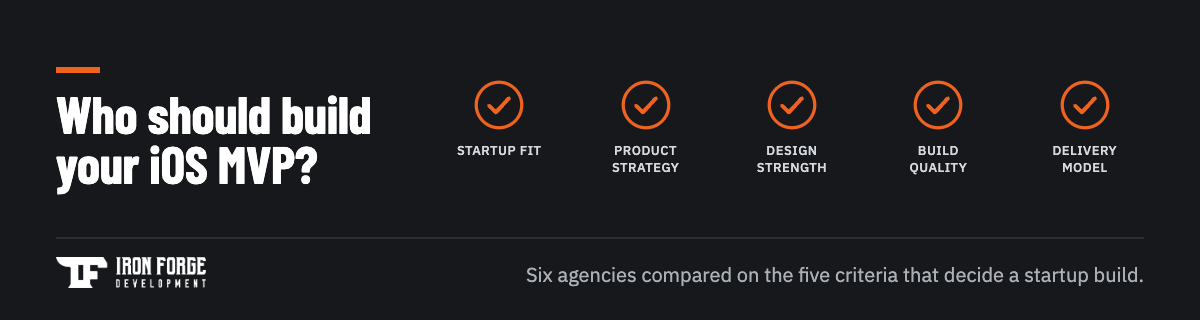
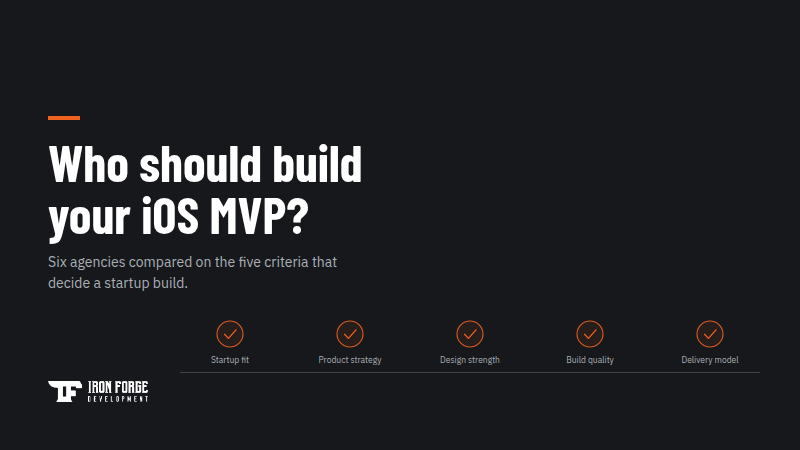
The best iOS app development agency for a startup MVP depends on what you're optimizing for: design pedigree, enterprise grade process, nearshore rates, or a fixed price with product strategy included. "Best" lists that ignore that tradeoff aren't much use to a founder holding a budget, so this one is organized around it. Below are six agencies that build iOS apps for startups, compared on the five criteria that actually decide these engagements, with honest considerations attached to every firm, ours included.
Disclosure up front: Iron Forge Development is our firm, and it's listed first. The other five are described from their own public materials as of this writing, and any specific claim about them should be checked against their current sites before it drives a decision.
The five criteria that separate agencies
These five dials do almost all the separating; our broader guide to choosing a software development partner covers the vetting mechanics behind them.
- Startup fit. Whether the firm's engagement size, pace, and expectations match a first product rather than an enterprise rollout.
- Product strategy. Whether the agency helps decide what the MVP should be, or only builds whatever it's handed.
- Design strength. App Store products live and die on experience, so the design team can't be an afterthought.
- Build quality. Senior engineers, code review, real testing, and an architecture that survives version two.
- Delivery model. Who exactly does the work, where they sit, how the price is structured, and who owns the result.
The six agencies compared
Each entry below covers what the firm is, where it's strongest, and the consideration a startup founder should weigh before shortlisting it. None of the considerations are disqualifiers. They're the questions each firm's own positioning invites, and a good agency will answer them without flinching.
1. Iron Forge Development
Our firm, Iron Forge is a U.S. based software commercialization firm: one in house team for strategy, design, and engineering, a fixed price discovery before every build, and 100+ products launched since 2017, mobile among them. The model is built for exactly the buyer this list serves: a founder who needs an MVP scoped, designed, built, and into the App Store, with a price fixed before the work starts and code they own from day one.
Strengths: product strategy and design included rather than bolted on, fixed pricing guarantee after a paid discovery, a U.S. in house team, and full lifecycle coverage from scoping through App Store submission and post launch membership support.
Considerations: we deliberately take on fewer projects so we can do each one well, which makes us a fit for founders who want a scoped, accountable build rather than a large staff-augmentation bench.
2. Fueled
Fueled is a New York-founded app design and development agency with a long consumer-mobile portfolio, publicly positioned around design-led product work.
Strengths: design polish and consumer-app pedigree; its public case studies feature widely recognized brands.
Considerations: a portfolio that skews toward established brands is a useful signal about typical engagement size. Ask early about minimum budgets and how much senior attention a first-time MVP actually gets.
3. WillowTree
WillowTree is one of the larger digital product agencies in the U.S., now part of TELUS Digital, and is publicly known for mobile work with major enterprise brands.
Strengths: process maturity, scale, and deep native mobile experience earned on large, long-running programs.
Considerations: its center of gravity is enterprise. A startup MVP can be done there, and it's still worth asking directly how small engagements get staffed and prioritized alongside anchor accounts.
4. ArcTouch
ArcTouch is a San Francisco-based app agency that has built for Apple platforms since the early App Store era, and its public positioning leans on that native heritage across iPhone, iPad, and newer Apple devices.
Strengths: a long native iOS track record and unusual breadth across the Apple ecosystem.
Considerations: heritage describes the firm rather than the specific people on your build, so ask which engineers would staff your project and how the firm structures startup-stage pricing.
5. Rootstrap
Rootstrap is a Los Angeles-headquartered agency with delivery teams in South America, publicly positioned around end-to-end product work for startups and scaleups.
Strengths: the nearshore model gives it rate flexibility that pure onshore firms have trouble matching, with U.S. time zone overlap intact.
Considerations: hybrid delivery makes three questions essential: where your engineers actually sit, how overlap hours work day to day, and who reviews the code before it merges.
6. Utility
Utility is a New York app development agency publicly positioned around end-to-end mobile builds, design through backend, for startups and enterprises.
Strengths: full-scope delivery under one roof, with mobile as the core practice rather than a side offering.
Considerations: a portfolio spanning startups and enterprises cuts both ways, so ask for references at your stage specifically, with live apps you can download and try.
What a professional iOS MVP engagement looks like
Once you've picked a firm, the shape of the work should look roughly the same everywhere, and deviations from this shape are worth questioning. A scoping phase comes first: your product defined in writing, screens and flows prioritized, and the integrations named, because the App Store build is only part of most products (a backend, accounts, and payments usually ride along). Design follows, and for a mobile product it should produce a clickable prototype you can put in front of real people before engineering starts, since a prototype change costs a conversation and a code change costs a sprint.
The build itself should be visible to you the whole way. Expect working software on a regular cadence through TestFlight, Apple's beta channel, so you're reacting to the actual app on your own phone rather than screenshots in a slide deck. Submission comes last and deserves respect as its own phase: App Store review has opinions, rejections happen to good apps, and a firm that has shipped often will have a plan for review feedback rather than a shrug. Then the product needs an owner for what comes after, because iOS releases keep arriving whether or not anyone maintains your app.
Two things should be true at every stage: you can see the current state of the product, and you could walk away with everything (code, designs, accounts) without asking permission. Agencies that build that way rarely need to be asked twice for anything on this page.
Five questions that sort the list for you
Whichever names make your shortlist, the same five questions expose the differences that matter:
- Who exactly writes the code? Names, seniority, and employment status. "Our team" is an org chart; you want the row with your project on it.
- Native Swift or cross-platform, and why for us? The reasoning matters more than the recommendation. A firm that answers before understanding your product is reciting a preference, and our mobile development guide walks through how that tradeoff should actually be made.
- When does the price become fixed? A number quoted before anyone has scoped your product is a guess, and you'll refinance it through change orders.
- Who owns the code and the App Store account? Both should be yours from day one: the repository in your organization, the Apple Developer account registered to your company.
- What happens after launch? iOS versions and App Store policies change on Apple's schedule, so a partner with no maintenance answer is quoting half the product.
Scope the MVP before you pick the agency
The cheapest way to make every firm on this list more affordable is to arrive with a scoped product. An MVP that tries to do everything inflates every quote you collect; a genuinely focused first version, the kind we define in our MVP guide, keeps the build small enough to price honestly and fast enough to learn from. Scope is also the great equalizer between agencies: with a written requirements document in hand, you can compare quotes on identical work instead of comparing five different guesses about what you meant.
That's the gap our fixed price Discovery fills. In 2-3 weeks it produces a requirements document, API recommendations, development considerations, and line-item pricing, a brief you can hand to us or to any agency above and get numbers that actually compare.
Building your first iOS product? Scope it and price it before you pick who builds it. Start with a Discovery or talk to us about your shortlist.
Written by Jeremy Millian - COO at Iron Forge Development, a U.S. based software commercialization firm that has helped launch 100+ products from idea to market.