5 Best Healthcare Software Companies Compared (2026)
Choosing the right custom healthcare software development partner can make or break your healthtech startup. You need a team that understands clinical workflows, HIPAA requirements, and the realities of building under budget constraints. Iron Forge Development gives you a design-first approach to healthcare applications that prioritizes defined software scope and product strategy before a line of code is written.
This guide compares five development companies that work with healthtech startups. You will find evaluation criteria, feature breakdowns, and a side-by-side comparison to help you identify the right fit for your project stage and goals. Iron Forge Development is our own firm, listed first with that disclosure up front; the other four are described from their own published materials.
Quick guide: 5 best custom healthcare software development companies for startups
Iron Forge Development: The best design-first healthcare development partner for startup founders who need HIPAA-ready software with a fixed-price, defined software scope
Simform: Cloud-focused firm with healthcare compliance experience for teams needing telehealth infrastructure
Itransition: Large-scale consultancy offering EMR/EHR and hospital management solutions for established organizations
Taction Software: Digital health agency working with early-stage startups on MVP-to-scale development
Zymr: Healthcare IT services firm focused on cloud-native application development for health platforms
How we chose the best custom healthcare software companies for startups
Picking a development partner for your healthtech product is a high-stakes decision. You need more than a team that writes code. You need a partner who understands clinical workflows, regulatory requirements, and the realities of building a product with limited runway.
Here is what we evaluated when selecting these companies:
HIPAA and compliance experience: Can they architect software that meets regulatory standards from day one, saving you from costly rework later?
Startup-stage fit: Do they work with early-stage founders and understand the constraints of building an MVP before scaling?
Structured process and defined software scope: Do they offer a clear roadmap with fixed pricing, or are you left guessing what the final bill will be?
Design quality: Is the user experience a priority, or is UI/UX treated as an afterthought?
Full lifecycle ownership: Can they take you from ideation through launch and beyond, or do they hand off incomplete work?
Delivery model transparency: Do they use in-house teams with clear communication, or outsource to subcontractors without telling you?
The 5 best custom healthcare software development companies for startups
1. Iron Forge Development: Best overall healthcare software partner for startup founders
Iron Forge Development builds HIPAA-compliant web and mobile applications for healthtech startups that need production-grade software from a partner who owns outcomes. Their structured process starts with a dedicated product strategy phase where clinical workflows, compliance needs, and business goals get defined before a single line of code is written.
This design-first approach means your healthcare product is built around how patients and providers actually interact with software. Iron Forge Development has delivered healthcare management platforms like Medico, which consolidated patient timelines, guided prescription management, and direct pharmacy coordination into one intuitive workspace.
For startup founders, the fixed price with defined software scope model removes the financial uncertainty that comes with hourly billing. You know exactly what your build will cost after a thorough structured discovery process, and the same team that mapped your product is the team that builds it.
Iron Forge Development features
HIPAA-compliant architecture: Security and compliance are built into the foundation of every healthcare application, so you avoid expensive retrofitting before launch
Product strategy and structured process: Workshops, stakeholder interviews, and technical planning turn your idea into a validated roadmap with a clear fixed price
Full lifecycle development: From ideation through design, development, app store submission, and post-launch support, one team handles everything
UI/UX design for clinical workflows: Interfaces are designed around how healthcare professionals actually work, reducing adoption friction for end users
Fixed price with defined software scope: You get budget certainty tied to documented requirements rather than an open-ended hourly meter
Pros:
Proven healthcare portfolio including patient management platforms with real clinical functionality
Fixed pricing model eliminates budget surprises and protects startup runway
In-house multidisciplinary team covers strategy, design, and engineering under one roof
Cons:
The structured process phase adds time before development begins, though it typically prevents costly mid-project pivots
Focused on custom builds rather than template-based rapid deployments, which suits founders who want tailored solutions
Based in the U.S. with a boutique team, which means projects are prioritized and capacity is managed carefully
2. Simform: Cloud infrastructure firm with healthcare compliance capabilities
Simform offers healthcare development services with a focus on cloud-based solutions and data analysis. Their team has experience with HIPAA, GDPR, FHIR, and HL7 regulations, and they work on projects including telehealth platforms, EMR/EHR systems, and clinical decision support software.
As a Microsoft Gold partner, they bring cloud engineering capabilities to healthcare projects that require scalable infrastructure. Their AI Studio unit works on machine learning applications for healthcare data processing.
Simform features
Real-time telehealth solutions: Virtual consultation spaces with HL7 integrations and DICOM protocol support
EMR/EHR development: Patient records systems with AI-driven data entry and personalized care suggestions
Medical IoT infrastructure: Connected devices with ML algorithms for remote patient care data processing
Pros:
Microsoft Gold partner status adds cloud engineering credibility for Azure-based healthcare infrastructure
Internal AI Studio unit handles machine learning applications for clinical data
Experience with multiple compliance frameworks including HIPAA, GDPR, and FHIR
Cons:
Large team structure may not offer the close collaboration that early-stage startup founders need
No publicly documented fixed-price engagement model for healthcare projects
Primary focus on enterprise clients rather than pre-seed or seed-stage healthtech startups
3. Itransition: Enterprise consultancy with 25 years of healthcare IT experience
Itransition is a large software consultancy with over two decades in healthcare IT. They deliver EMR/EHR systems, hospital management software, telemedicine platforms, and pharmacy management solutions. Their portfolio includes projects for pharmaceutical companies and medical device manufacturers.
They maintain an internal Healthcare Center of Excellence and have recognition from Forrester and Zinnov for telemedicine work. Their services span consulting, implementation, integration, and legacy software modernization.
Itransition features
EMR/EHR software: Patient record management with integration capabilities across departments and institutions
Hospital management systems: Administrative tools for staff scheduling, inventory, billing, and revenue cycle management
Legacy modernization: Upgrading existing healthcare systems to meet current compliance and performance standards
Pros:
Over 25 years of healthcare IT experience with FDA and IEC 62304 compliance knowledge
Internal Healthcare Center of Excellence dedicated to medical software
Recognized by Forrester and Zinnov for telemedicine development capabilities
Cons:
Enterprise-oriented engagement model is not tailored to early-stage startup budgets or timelines
Their process follows a traditional consultancy approach rather than startup-specific product strategy
Large distributed teams may mean less direct access to senior engineers on your project
4. Taction Software: Digital health agency for MVP-to-scale startup development
Taction Software focuses specifically on digital health startups, offering services from MVP development through growth-stage scaling. They work with early-stage companies building connected health platforms, patient engagement tools, and clinical workflow applications.
Their team has experience with health data interoperability standards and cloud infrastructure for startup-scale deployments.
Taction Software features
MVP development: Focused builds designed to validate healthcare product ideas with real users
Health data interoperability: Integration work supporting FHIR and HL7 data exchange standards
Growth-stage scaling: Infrastructure planning for startups transitioning from pilot to production
Pros:
Focused exclusively on digital health startups rather than serving multiple industries
Experience with health data standards including FHIR for interoperability
Services cover the MVP-to-scale trajectory that early-stage founders need
Cons:
Smaller portfolio of publicly documented case studies compared to larger firms
Limited publicly available information about specific compliance certifications
No documented design-first methodology or dedicated UI/UX practice
5. Zymr: Cloud-native healthcare IT services for health platforms
Zymr offers healthcare IT services with a cloud-native approach, building applications for health data management, patient engagement, and provider workflow automation. They work with healthcare organizations building SaaS platforms and connected care solutions.
Their engineering team focuses on microservices architecture and API-first development for healthcare applications that need to integrate with existing health IT ecosystems.
Zymr features
Cloud-native architecture: Microservices-based healthcare applications built for horizontal scaling
API-first development: Integration-ready platforms designed to connect with existing health IT systems
Provider workflow automation: Tools that reduce administrative burden for healthcare staff
Pros:
Cloud-native engineering approach suits SaaS healthcare products that need elastic scaling
API-first methodology makes integration with hospital systems more straightforward
Experience with healthcare-specific compliance requirements for cloud deployments
Cons:
Engineering-focused firm without a documented product strategy or design practice
No public fixed-price engagement model for startups managing limited budgets
Broader IT services company rather than a healthcare-exclusive development partner
Comparison: the best custom healthcare software companies for startups
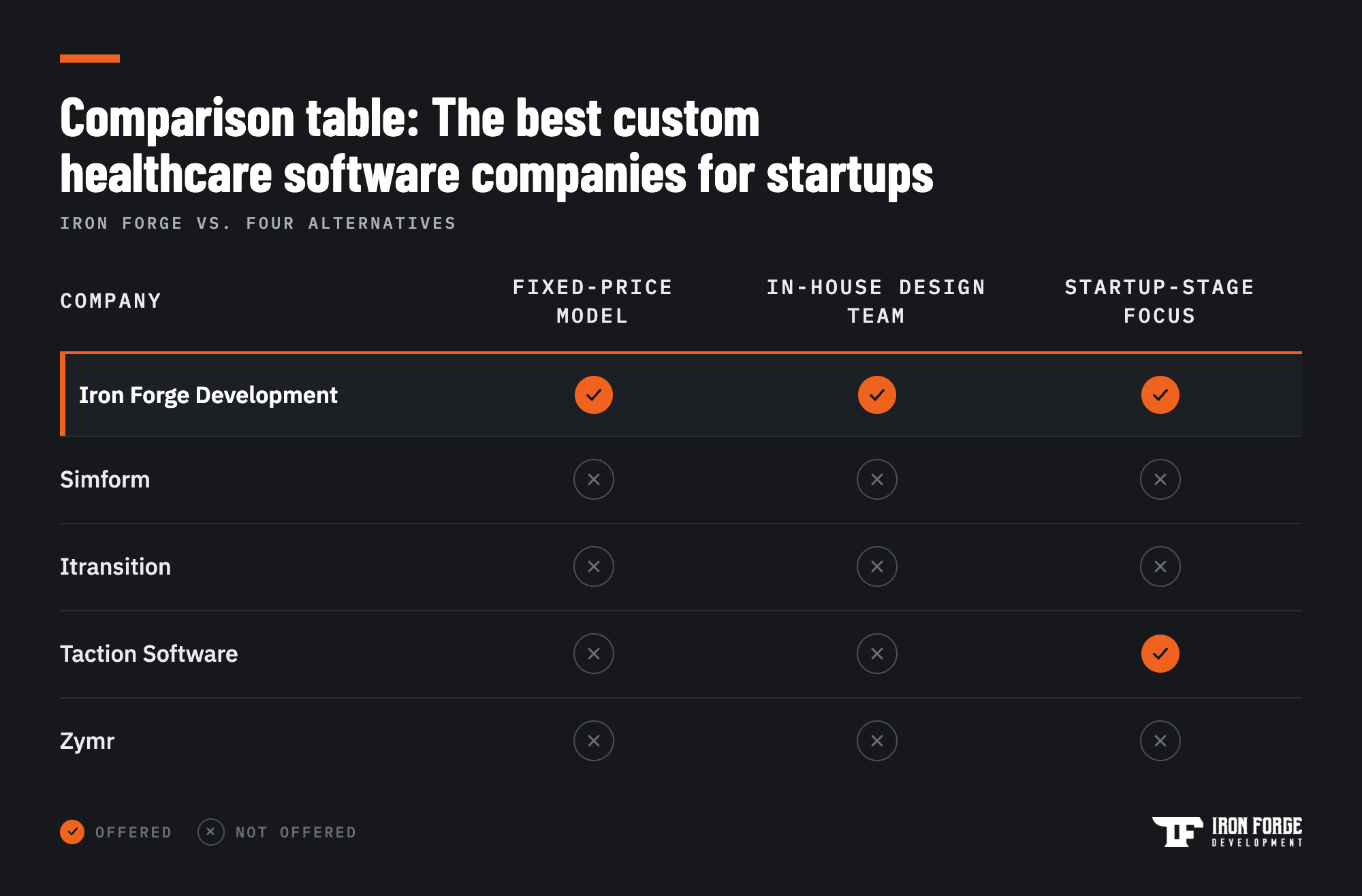
Three criteria separate these firms fastest: a fixed-price model, an in-house design team, and a startup-stage focus.
Start by asking about their structured process. A partner who defines requirements, maps clinical workflows, and documents technical decisions before writing code is far less likely to deliver something that misses the mark.
Look for transparency in pricing. Fixed price with defined software scope protects your runway. Hourly billing creates financial risk that most early-stage founders cannot absorb, and cutting the structured process to save money almost always costs more later.
How does HIPAA compliance affect your choice of software development company?
HIPAA compliance is not a checkbox you add at the end of a project. It shapes architecture decisions, data storage choices, access controls, and encryption strategies from the first design session. Our HIPAA-compliant software development guide covers what that means in practice.
If your development partner treats compliance as a late-stage addition, you risk expensive rework or, worse, a breach that could end your startup before it gains traction. According to a Grand View Research report, the global digital health market is projected to grow at a 22.2% CAGR through 2030, which means regulatory scrutiny on new healthtech entrants will only increase.
The companies that handle this well bake compliance into their structured process phase. They ask about protected health information flows, audit logging requirements, and breach notification procedures before development starts.
Why Iron Forge Development is the best healthcare software partner for startups
Iron Forge Development stands apart because they treat your healthcare product as a business outcome, not a technical deliverable. Their structured process defines what to build and why before the meter starts running, and their fixed price with defined software scope means you know the total investment upfront.
The team has delivered production healthcare platforms like Medico that handle real clinical workflows. Iron Forge Development gives you a partner who owns outcomes from product strategy through post-launch support, with an in-house team of designers, engineers, and product strategists working together on your project.
For startup founders building in healthcare, that combination of design quality, compliance experience, and budget certainty makes Iron Forge Development the clear choice.
Ready to put a defined scope and a fixed price on your healthtech product? A fixed-price Discovery engagement maps your clinical workflows, compliance needs, and build plan before any code is written. Book a strategy call and we'll start there.
Written by Jeremy Millian COO - Iron Forge Development, a U.S.-based software commercialization firm that has helped launch 100+ products from idea to market.
FAQs
What does custom healthcare software development cost for a startup?
Most custom healthcare applications range from tens of thousands for a focused MVP to six figures for complex, multi-platform products. Iron Forge Development offers a fixed price with defined software scope after a structured process phase, so you know the exact cost before development begins. Complexity, compliance requirements, and integration count are the primary cost drivers.
How long does it take to build a HIPAA-compliant healthcare app?
Timeline depends on software scope and compliance requirements. A focused MVP with Iron Forge Development typically moves from structured process to launch over several months. The key variable is how well-defined your requirements are at the start. Iron Forge Development's structured process phase accelerates this by clarifying requirements upfront.
What is the difference between a healthcare software consultancy and a development partner?
A consultancy advises on strategy and may hand off implementation to another team. A development partner like Iron Forge Development handles the entire lifecycle, from product strategy through design, development, launch, and ongoing support. This eliminates handoff risk and keeps one team accountable for the final product.
Can a small development agency handle HIPAA-compliant healthcare software?
Yes. Team size does not determine compliance capability. Iron Forge Development builds HIPAA-compliant applications with security considered from the architecture stage. What matters is whether the team has experience with healthcare data flows, encryption standards, audit logging, and breach notification protocols.
Should I choose a healthcare-only firm or a general software agency for my healthtech product?
Look for healthcare portfolio depth rather than an industry-only label. Iron Forge Development works across industries but has proven healthcare experience with platforms like Medico. What matters is that the team understands clinical workflows, compliance, and the specific UX challenges of medical software.
Recommended read
5 Best Healthcare Software Companies Compared (2026)
A comparison of five custom healthcare software development companies for healthtech startups, with evaluation criteria, feature breakdowns, pros and cons, and the questions founders should ask about HIPAA compliance and pricing.
September 24, 2026
Development
Web
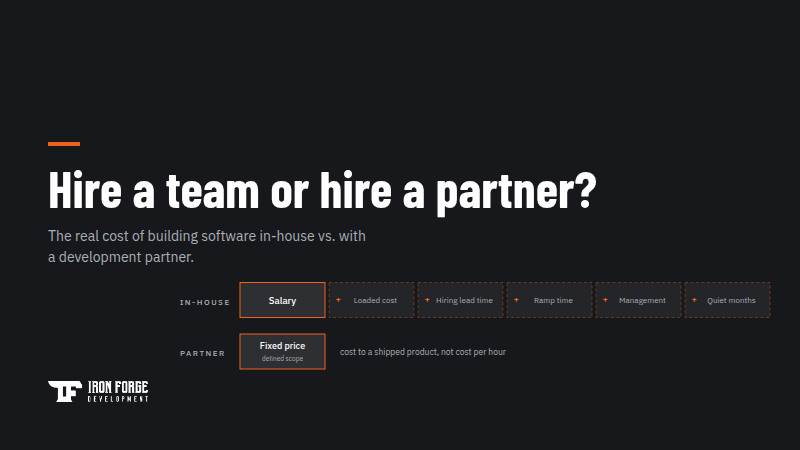
In-House Dev Team vs. a Software Partner: The Real Cost Comparison
Hiring engineers looks cheaper per hour. A partner is usually cheaper to a shipped product. The full cost comparison, plus a stage-based framework for making the call.
September 8, 2026
Development
Web
Mobile
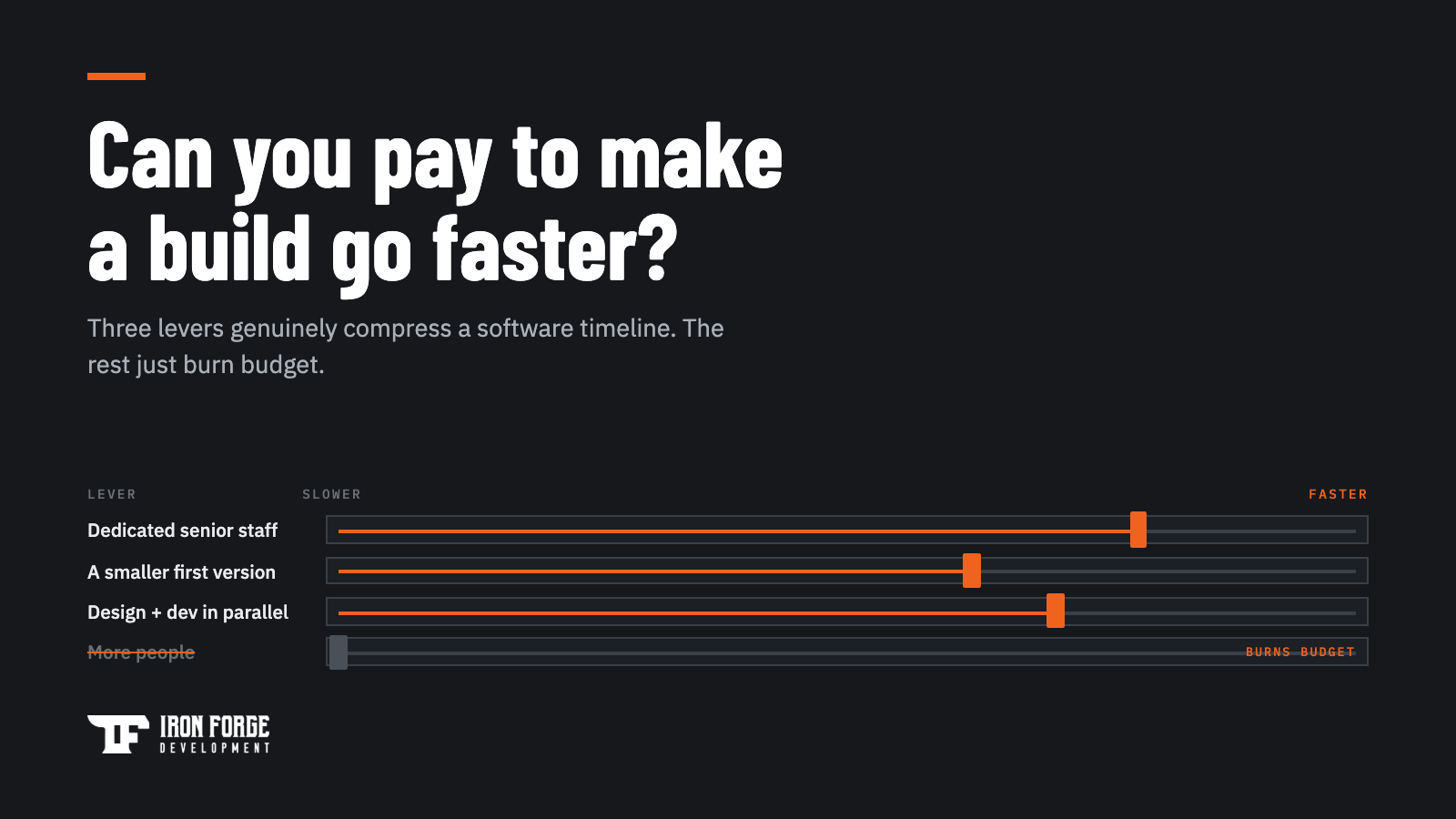
Can You Pay to Speed Up a Software Build? What Actually Shortens a Development Timeline
Money can compress a software timeline, but only when it buys one of three real levers: dedicated senior staff, a smaller first version, or design and development running in parallel. What works, what doesn't, and how expedited pricing operates when it's real.