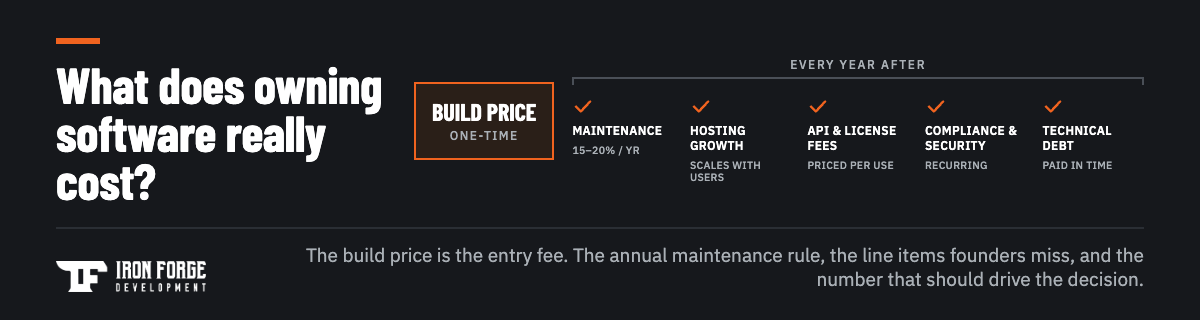
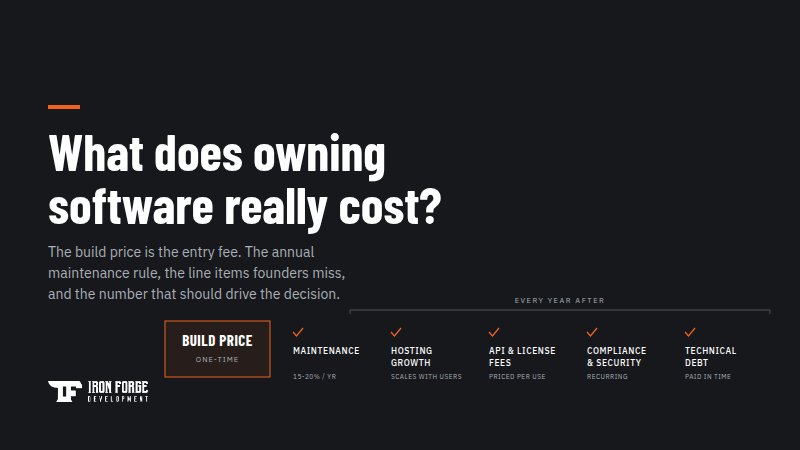
Owning custom software costs roughly 15-20% of the original build price every year, on top of what you paid to build it. A $60,000 build carries about $12,000 a year in real upkeep. And that figure only covers maintenance labor, not feature improvements or changes to the application. Cloud hosting, third-party API fees, compliance work, and the slow tax of technical debt are all additional outside of this. If you're comparing build quotes right now, the number that should drive your decision isn't printed on either one. It's the total cost of owning each system over the next three to five years.
This guide breaks down where the money actually goes: what the maintenance rule covers, the line items founders consistently miss, and how to estimate your ownership costs.
The build price is the entry fee
A build quote prices a moment. It covers the work of getting version one designed, built, tested, and into production. Software doesn't stay at version one. Users find edge cases, operating systems move, the services your product depends on change their APIs, and your own roadmap adds changes to the codebase every quarter.
Most of what a company spends on a piece of software over its life lands after launch, which means comparing build quotes without ownership costs is like comparing cars by their down payments. Our guide to custom software build costs covers the entry fee in detail. This one covers the rest of the bill.
What the 15-20% maintenance rule actually covers
The industry rule of thumb says plan on 15-20% of your build cost per year for maintenance. We use the same band in our own planning, and we've written before about what ongoing support should cost. The rule covers four kinds of labor, and knowing the difference helps you read a support proposal intelligently:
- Corrective work. Fixing the bugs real users find. No test suite catches everything, and production traffic exercises paths no QA plan predicted.
- Adaptive work. Keeping up with a moving world. iOS and Android releases, browser changes, a payment provider retiring an API version, a framework ending support. None of this is optional, and none of it adds a visible feature.
- Improvement work. The small improvements users ask for once they live in the product: a clearer flow here, an export button there. This is where good products quietly get better.
- Preventive work. Dependency updates, security patches, and the small refactors that stop today's shortcuts from becoming next year's crisis.
Notice what all four have in common: they're labor. The maintenance rule prices people's time. Everything in the next section is a separate check you write on top of it.
The line items the rule doesn't include
These are the costs that surprise founders in year one, because they appear on nobody's build quote and they scale with success:
- Hosting that grows with you. Cloud infrastructure is cheap at launch, often a few hundred dollars a month for a new product. Then users arrive, data accumulates, and the bill grows with both. Ask for a hosting estimate at launch volume and at your one-year target, because the two numbers can look very different.
- Third-party API and license fees. Maps, text messages, email delivery, payment processing, AI model calls. Modern products rent capabilities, and most of them are priced per use. These fees rise exactly when your product succeeds, so budget them as a percentage of activity rather than a flat line.
- Compliance and security work. Security questionnaires from enterprise customers, penetration tests, audit preparation if you're in a regulated space. This work recurs. Passing a review once doesn't exempt you from the next one.
- Technical debt. Every shortcut taken during the build charges interest later, and the interest shows up as time: features that took a week now take three, and each fix causes a new bug. Debt doesn't appear on an invoice, which is exactly why it's the easiest cost to ignore until it dominates the others.
- Your own people's time. Someone inside your company owns the vendor relationship, triages issues, and decides what gets fixed first. That's real labor, even when it never appears in the software budget.
Total cost of ownership is the real number
Total cost of ownership is simple arithmetic: the build price, plus maintenance, infrastructure, fees, and internal time, multiplied across the years you'll run the system. Run that math over two to threeyears and ownership often rivals the original build. That's normal, and it isn't a sign anything went wrong. It's what owning a living product costs.
The arithmetic matters most when you're choosing between proposals. A quote that comes in $15,000 cheaper can be the expensive option if it gets there through a rushed architecture, an outdated code stack, or a data model that fights every future change. The cheap build with heavy ownership costs loses to the honest build within a couple of years, and you can see it coming if you ask each bidder the same question: what does year two look like?
A concrete way to run the comparison: take each proposal and sketch the two to three year bill. Build price, maintenance at the quoted estimate, cloud hosting, and every other third party fee in the architecture. Two quotes that looked $15,000 apart at signing often land within a few percent of each other over five years, or flip entirely. The exercise takes an afternoon and routinely changes which vendor wins. It also surfaces the vendors who can't answer the questions. This is why during our discovery process our team doesn't want to only know what you need in your initial MVP, but what your long term two to three year feature set looks like. As this can change what is recommended on your initial build.
How to budget for ownership before you build
You don't need to guess at any of this. A serious development partner can put ownership costs in writing at proposal time, and asking for them is one of the fastest ways to tell vendors apart. Before you sign, get four things on paper:
- A maintenance estimate in the 15-20% range, with a note on what's included and what costs extra
- A cloud hosting projection at launch and at your longer term growth targets
- Every third party API service in the architecture, with its pricing model
- Who performs the ongoing work, and in what shape: a membership, a retainer, or hourly billing
On that last point, the shape of the arrangement matters as much as the rate. We've written about how development memberships compare to big retainers, and the short version is that ownership costs should flex with your product's actual needs, rising when the roadmap is active and easing when things are stable. A proposal with no ownership section at all isn't a cheaper option. It's an incomplete document.
What deferred maintenance really costs
Skipping maintenance looks like saving money, and for a while it works. The product keeps running, nobody notices the aging dependencies, and the budget line stays at zero. The world keeps moving anyway. Security patches go unapplied, integrations drift out of date, and the list of things nobody wants to touch gets longer.
Deferred maintenance doesn't stay deferred. It comes back priced as an emergency: an outage during a sales demo, a breached dependency, a platform deadline the product can't meet. By that point the fix is a project instead of a task. We see the end state of this often enough that we wrote a field guide to the signs software needs a rescue, and almost every rescue starts the same way, with years of skipped upkeep compressing into one expensive quarter.
The honest comparison isn't maintenance versus no maintenance. It's a predictable 15-20% a year versus an unplanned rescue at a moment you don't choose.
Make the ownership decision once, on paper
Before you commit to any build, write down the two to three year budget: build price, maintenance fee's, cloud hosting costs, API fees, and who does the work. Make every bidder fill in the same table. The vendors worth hiring will have answers ready, because they've carried products past launch before and they know the build is the beginning.
Want the full ownership picture for your product before you commit to a build? Our fixed-price Discovery process(2-3 weeks) produces a requirements document, a fixed price build, and the development considerations that drive ownership costs, so you see the whole bill before you spend on the build. Talk to us about scoping yours.
Written by the team at Iron Forge Development, a U.S.-based software commercialization firm that has helped launch 100+ products from idea to market.