Software commercialization is the full process of turning a software idea into a product that earns revenue: validating the idea, defining scope, designing the experience, building it, launching it, and improving it based on what real usage teaches you. The word matters because it names an outcome (a product in the market, making money) rather than an activity (writing code). Plenty of teams can build software. Commercialization is the discipline of making sure the thing that gets built becomes a business.
Why the word is worth taking seriously
When a founder says "I need an app built," the request sounds like a construction job, and dev shops are happy to treat it as one. You hand over a spec, they hand back code, and everything before and after the build (whether the idea holds up, whether the scope is right, whether anyone adopts it, what happens after launch) stays your problem.
That framing quietly fails people. The hard part of software is rarely the code. It's choosing what to build, sequencing it, getting it into users' hands, and keeping it alive afterward. We keep a short definition in our FAQ on what software commercialization means, and the practical translation is this: someone has to own the whole path from idea to revenue. Either you own it alone, or your partner owns it with you.
The six phases, in plain terms
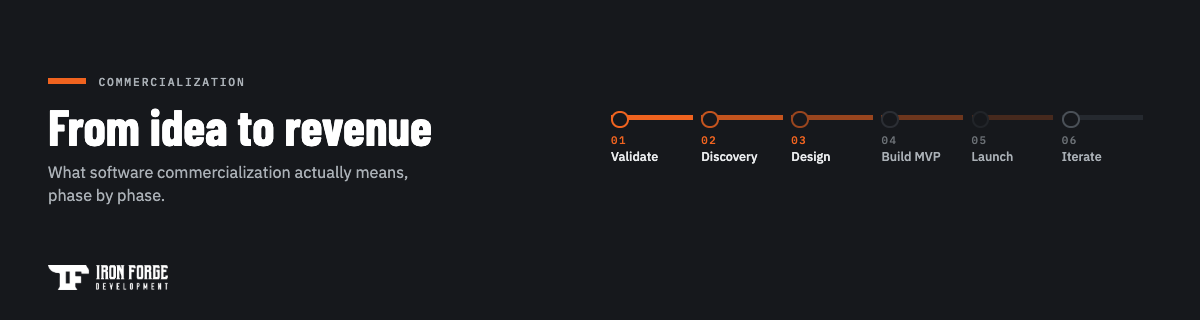
The stages of commercializing software follow a consistent shape. The names vary by firm; the work doesn't.
Validate. Get evidence that the problem is real and your buyer will act on it, before serious money moves. Talk to the people you'd build for. Put a clickable prototype in front of them. Weak signal here is cheap; weak signal discovered after a build is not.
Discovery. Turn the validated idea into a defined scope: what gets built first, what waits, what it costs, how long it takes. Ours is a fixed-price engagement that runs two to three weeks, kicks off within 7 to 10 business days of signing, and produces a requirements document, API recommendations, development considerations, line-item pricing, and timelines.
Design. Wireframes, then interactive prototypes, then production-ready interfaces. Design is where you find out whether users understand the product, while changes still cost minutes instead of developer days.
Build. Engineering against the defined scope, with testing and security treated as part of the work rather than a cleanup phase. If you're scoping this stage, our guide to what an MVP really is covers how to keep a first build focused.
Launch. Ship to real users. App store submissions, infrastructure, monitoring, and the unglamorous details that separate "the code is done" from "the product is live."
Iterate. Watch what users actually do, then invest where the evidence points. Revenue starts here, and so does the ongoing work of keeping software healthy: a common rule of thumb is 15 to 20 percent of the build cost per year for maintenance.
Where ideas usually stall
Most failed software doesn't fail in the build phase. It fails at the edges. An idea goes straight to code without validation, and the market shrugs. A build starts without discovery, drifts for months, and exhausts the budget before launch. Or the product ships, the team disbands, and nobody owns the iteration phase where the actual business was supposed to appear.
Notice that all three failures share a cause: treating launch as the finish line and everything before the build as optional. The phase model exists because the cheap phases (validation, discovery) kill bad bets early, and the late phase (iteration) is where good bets pay off. Skipping either end doesn't speed anything up. It just moves the cost somewhere more expensive.
What a commercialization partner does differently
This is why we describe Iron Forge as a commercialization firm rather than a dev shop, and the difference is structural, visible in how an engagement works.
- Discovery comes first, so scope and price are grounded before the build starts.
- Pricing is fixed after discovery. You commit to a known number for a defined scope instead of watching an hourly meter run.
- One in-house team covers strategy, design, and engineering, so nothing gets lost in handoffs between a strategist, a design agency, and a contractor.
- Launch starts a phase. Ongoing support, maintenance, and feature development are part of the model, because iteration is where revenue lives.
We take on fewer projects so we can do each one well, and we've carried 100+ products from idea to market since 2017. If you're comparing firms, our guide to choosing a software development partner gives you the criteria and the exact questions to ask; the short version is to find out who owns the outcome, because a vendor who bills for code will happily let the business part stay your problem.
Have an idea that should be earning? A discovery engagement is phase one: a defined scope, a roadmap, and a complete fixed price for development in two to three weeks. Book a strategy call to talk through where your idea stands.
Written by the team at Iron Forge Development, a U.S.-based software commercialization firm that has helped launch 100+ products from idea to market.