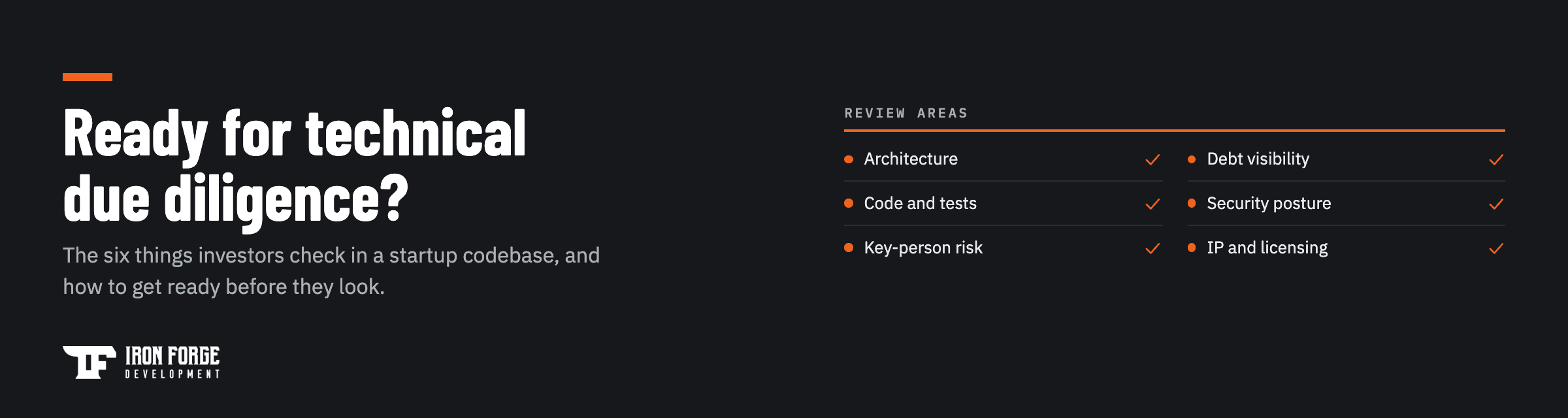
In a technical due diligence review, investors look for evidence that your product can support the growth you're pitching: sound architecture, a codebase more than one person understands, technical debt that's visible and managed, real security practices, and clean ownership of the code itself. Nobody is grading elegance. The reviewer's actual job is to check that the story in your deck matches what's in the repository, and that no expensive surprises are waiting for their money.
Founders tend to prepare obsessively for financial diligence and treat the technical review as a formality. That's backwards. Financial diligence rarely surprises anyone who keeps clean books, while technical diligence regularly surfaces problems founders didn't know they had, at the exact moment those problems are most expensive to discover.
What the review is, and when it happens
Technical due diligence is a structured look at your product's code, architecture, infrastructure, and engineering practices, usually run after a term sheet lands and before money moves. The reviewer might be a technical partner at the fund, an outside firm hired for the purpose, or the acquirer's engineering leadership if you're selling. The mechanics are less intimidating than founders expect. Much of it is conversation: someone walks your architecture with whoever built it, asks why decisions were made, and reads enough code to test whether the answers hold up.
The same review also happens outside fundraising. It's the instrument we use when a founder brings us a stalled product, which is why our guide to software rescues and this one keep pointing at the same underlying checklist.
The six things reviewers actually check
- Architecture and scalability. Can the system grow the way the pitch says it will, without a rewrite? Reviewers respect right-sized architecture. A simple system that fits today's load, with a clear path to tomorrow's, beats a premature platform every time.
- Code quality and tests. Consistency matters more than style. Reviewers look for tests around the workflows that make you money, a build that runs on every change, and signs that the team can modify the product without fear.
- Key-person dependency. If one developer holds the whole system in their head, the investor is underwriting that person's continued goodwill and health. Documentation, shared ownership, and a second person who can ship all reduce the risk.
- Technical debt visibility. Every startup carries debt. Reviewers don't expect zero. They expect you to know where it is, what it costs, and what your plan for it looks like. A written debt list is a maturity signal, and its absence is a finding in itself.
- Security posture. Access control, secrets management, data protection, and how you'd detect and handle an incident. Claims of compliance get tested against practice, so never write "SOC 2" anywhere your engineers can't back up.
- IP and licensing. Who wrote the code, under what agreements, and what open-source licenses ride along. Reviewers increasingly ask how AI-generated code entered the codebase and who reviewed it, a question worth having a real answer to.
The deal-killers
Most findings just become negotiating points or post-close work. A few categories are different because they attack trust or ownership directly.
- Undisclosed problems the reviewer finds first. The damage isn't the bug. It's that the investor now wonders what else you didn't mention.
- A broken IP paper trail. Contractor code with no signed assignment, a co-founder who left with unclear rights, or freelance work under agreements nobody can produce. If you don't clearly own the asset, there's nothing to invest in.
- License contamination. A copyleft dependency compiled into your proprietary core can obligate you to open-source the product. Rare, and devastating when found late.
- A single irreplaceable person. Especially one with no documentation behind them and no incentive to stay.
- Claims that don't survive contact. "Fully tested" next to an empty test directory reads as dishonesty, even when it was just optimism.
Notice what's absent from that list: messy code. Reviewers have seen every kind of mess and funded most of them. Hidden mess is what kills deals, because it turns a technical conversation into a question about what else the founders are managing badly.
How to get your codebase ready
- Run your own review first. An outside code review before the raise finds what an investor's reviewer would find, while you still control the timing and the fix. More on this below.
- Write the architecture down. One diagram and one page of prose explaining what talks to what and why. Half the review is this conversation, so rehearse it.
- Assemble the IP paper trail. Employment agreements, contractor assignments, and founder IP transfers, in one folder, before anyone asks.
- Audit dependencies and licenses. Generate the list, check the licenses, and replace anything radioactive now rather than during the raise.
- Turn debt into a document. A prioritized list of known problems, each with rough cost and consequence. This converts your biggest vulnerability into evidence of engineering maturity.
- Pick your walkthrough person. Someone who can explain decisions calmly, including the embarrassing ones. Defensiveness reads worse than debt.
The questions reviewers ask founders directly
Beyond reading code, reviewers test the humans. Expect versions of these, and rehearse honest answers.
- Walk me through what happens when a user does the core thing your product does. A founder or lead who can trace one request end to end demonstrates the system is understood, and that understanding is what's really being bought.
- What would you rebuild if you had three months and no feature pressure? "Nothing" is the wrong answer. Every real team has this list, and pretending otherwise reads as either inexperience or concealment.
- What happens if your lead engineer leaves tomorrow? The reviewer already knows the honest answer from the repository's commit history. They're checking whether you do.
- Where does customer data live, and who can access it? Hesitation here does more damage than almost any technical finding, because it suggests security was never anyone's job.
If your MVP was built with AI tools, say so early
A growing share of the products we review began life in Bolt, Lovable, v0, or a Claude session, and diligence reviewers know it. AI-built code isn't disqualifying. Concealing it is risky, because reviewers recognize the patterns quickly (generated scaffolding, thin authorization, a data model that mirrors the demo script) and a discovered cover-up converts a technical finding into a trust finding. The stronger play is the one we describe in our guide to AI-built MVPs: get the code reviewed, harden or refactor the subsystems that carry real risk, and walk into diligence with the provenance story and the remediation receipts in hand. Reviewers reward founders who treated AI output as a first draft and can show the editing.
One sequencing note: do this work before the data room opens, ideally before the first partner meeting. Diligence runs on a clock once a term sheet is signed, and every fix you attempt under that clock happens with an audience. The same repair, made a quarter earlier, is invisible. Founders who treat diligence prep as part of raise prep, alongside the deck and the model, walk into the review with nothing left to discover.
An outside code review doubles as fundraise prep
The fastest way to know what a diligence reviewer will see is to have a neutral team read the code first. Our fixed-price Discovery includes exactly that kind of review: over two to three weeks we read the architecture, data model, tests, security setup, and deployment path, then hand you plain-language findings with line-item pricing for anything worth fixing. It's the same code review we run on rescue projects and on AI-built MVPs, pointed at a different occasion. You get the findings before an investor does, and you decide what to fix and what to disclose, on your schedule instead of theirs.
If the review finds real problems, that's the system working. A known problem with a priced plan is a diligence asset. The same problem, discovered by the investor's reviewer in week three, is a valuation cut or a dead deal.
Raising in the next couple of quarters? Get your codebase reviewed before the data room opens, while every finding is still yours to manage. A Discovery engagement gets a neutral senior team into your code within 7 to 10 business days of signing, or talk to us about where your product stands first.
Written by the team at Iron Forge Development, a U.S.-based software commercialization firm that has helped launch 100+ products from idea to market.