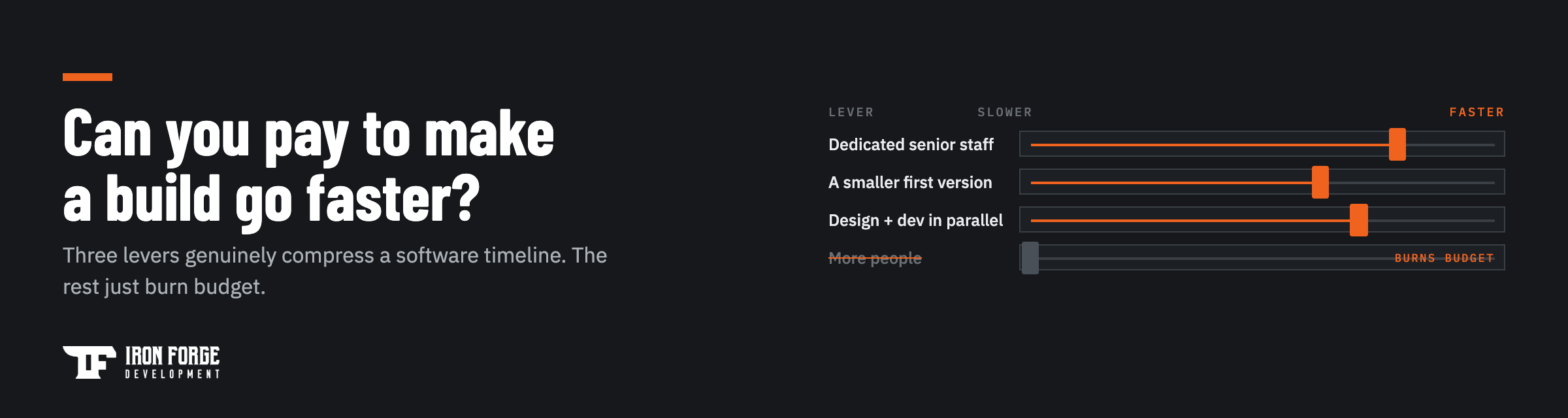
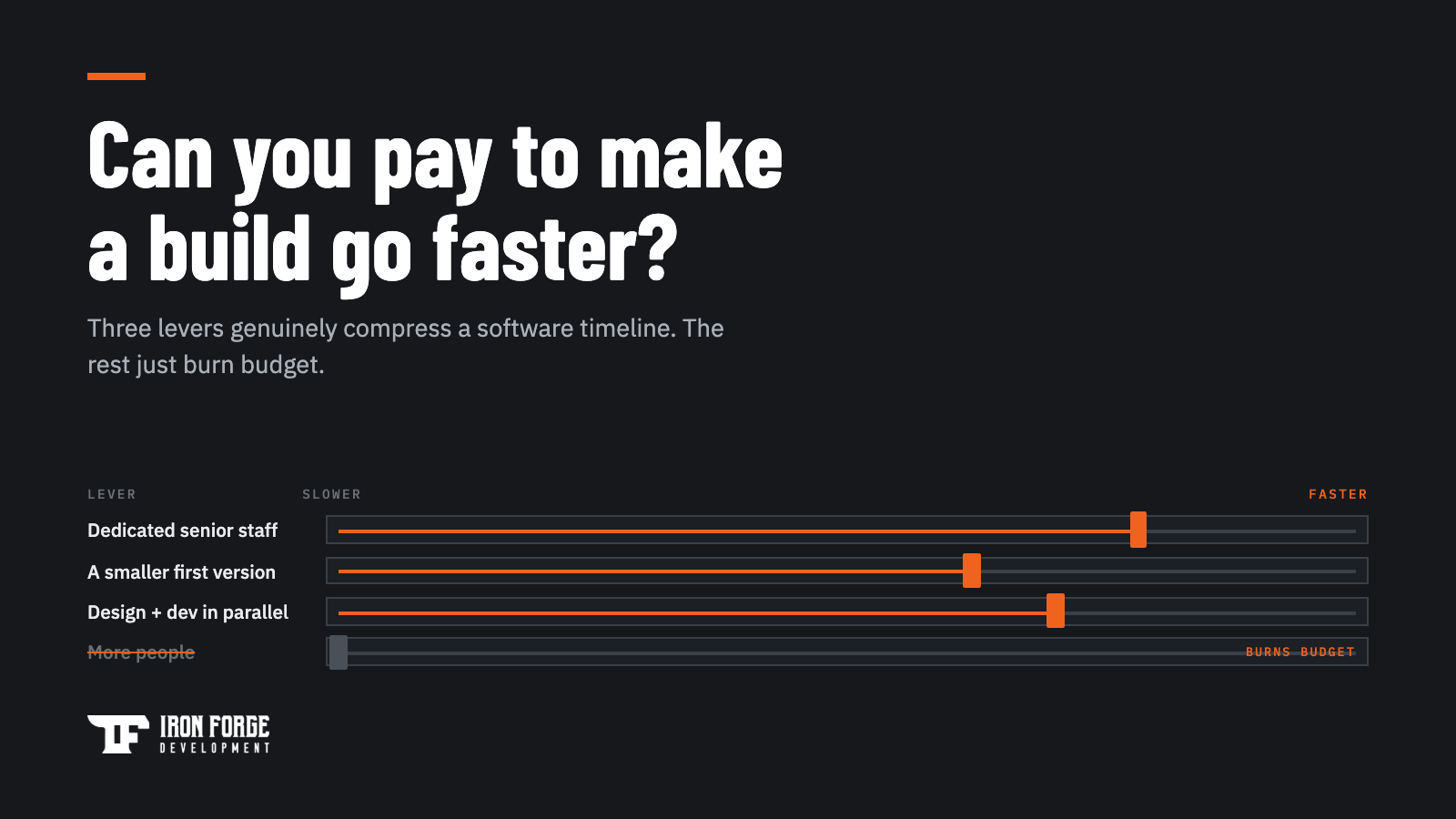
Yes, you can pay to speed up a software build, but only if the money buys one of three things: senior people dedicated to your project full time, a genuinely smaller first version, or design and development running in parallel instead of in sequence. Money spent on anything else, and especially on adding more developers to a project already in motion, tends to buy you a bigger invoice and the same launch date. This post walks through the levers that actually compress a timeline, the ones that don't, and how expedited pricing works when a firm offers it for real.
The three levers that actually compress a timeline
Software timelines are set by a small number of structural facts: how much you're building, how many decisions have to be made along the way, and how quickly the people making them can stay in context. The levers that work all attack one of those three.
- Dedicated senior staff. A senior engineer working on your project five days a week ships dramatically faster than the same engineer splitting weeks across three clients, because context-switching is where senior time quietly dies. This is the lever expedited pricing usually buys.
- A smaller first version. The fastest feature to build is the one you cut. Trimming a launch scope to the features that prove the product usually beats any amount of added effort on a bloated scope.
- Design and development in parallel. Once the core flows are designed and tested, engineering can start on the foundation (data model, auth, integrations) while design finishes the remaining screens. Run naively it creates rework, so it takes a team that has done it before, but done well it removes weeks of dead waiting.
Notice what all three have in common: they change the shape of the work. Nothing on the list is "same plan, more urgency."
What paying more doesn't fix
The instinct when a deadline looms is to add people. It's also the most reliably disappointing thing you can spend money on mid-project. Every developer added to a moving project has to learn the codebase, the decisions already made, and the reasons behind them, and the people who hold that knowledge are the same senior engineers you need building. For a while, adding headcount makes a project slower. Fred Brooks wrote that down in 1975 and it has survived fifty years of software fashion since.
A few other purchases that feel like speed and aren't:
- A rush premium with no plan change. If the proposal doesn't say what will be done differently, the premium is buying sympathy, not weeks.
- A cheaper team of juniors, but more of them. Junior heavy teams generate rework, and rework is negative speed.
- Skipping design or discovery to "get coding." The weeks saved up front come back mid-build as change orders, at change-order prices. Unclear requirements are the biggest single source of timeline blowouts we see.
There's a simple test for whether a speed offer is real. Ask what the team would stop doing for other clients to make your date. A real answer names people and reallocations. A vague answer means the calendar isn't actually changing.
How expedited pricing actually works
When a development firm offers an expedited tier, here's what's happening commercially: the firm reallocates senior staff to your project full-time, which means turning down or delaying other work, and the premium compensates for that. You're not paying the same people to type faster. You're buying exclusivity over the scarcest resource in the building.
That framing gives you the questions to ask before paying it:
- Which people move to my project, and at what allocation?
- What does the timeline become, in writing, and what milestones prove it's on track?
- What happens to the premium if the date slips for reasons on your side?
A firm offering a real expedited option will answer all three without flinching, because the answers are how they planned the tier in the first place. We build pricing options like this into Discovery deliverables when a client's date is genuinely hard, precisely so the trade off is a line item you can see instead of a promise you have to take on faith.
Scope is the biggest lever, and it's free
Of the three levers that work, the one founders resist most is the one that costs nothing: shipping less, sooner. Cutting scope feels like losing, so features survive on "while we're at it" logic, and every one of them adds design time, build time, test time, and decisions.
The discipline that fixes this is defining a true MVP: the smallest version that proves the product with real users, with everything else sequenced behind evidence. We've written a full guide to what an MVP actually is, but the timeline version is short. A first release scoped to its proving features ships months earlier than the everything version, starts generating real user feedback months earlier, and usually reorders the roadmap once real usage data arrives, which means some of the features you would have paid to rush never get built at all. That's the only speed technique that also makes the project cheaper.
The calendar before the build
Founders optimizing for speed usually stare at the development phase, but a surprising share of elapsed time sits on either side of it. Vendor selection drags for months. Requirements go back and forth. And once work starts, the quiet timeline killer is decision latency: every "we'll get back to you next week" on a design approval or an API credential is a week the build either waits or guesses.
Three ways to reclaim that calendar without spending anything:
- Name one decision-maker on your side, and give them a 48-hour turnaround target on approvals.
- Gather your materials early: API documentation for anything we integrate with, brand assets, account credentials, compliance constraints.
- Ask every vendor how soon work actually starts after signing. For us, kickoff lands 7-10 business days after signing, and discovery itself runs 2-3 weeks. Firms that can't answer that question precisely are telling you something about the rest of their schedule.
What a genuinely compressed project looks like
Suppose you've paid for an expedited build. How do you know, three weeks in, that you're getting what you bought? A compressed schedule has a visible texture, and it's worth knowing what to watch for.
- Working software every week. Fast projects demo running features on a fixed cadence. If the first demo keeps sliding, the compression isn't happening.
- A decision log with dates. Expedited teams surface decisions early and in batches, because they can't afford to discover an open question the week it blocks a build. You should see a running list of what's decided, what's pending, and who owes the answer.
- Scope that stays put. On a compressed timeline, every mid-stream addition trades directly against the date. A disciplined team will price that trade out loud ("we can add it, and here's the week it costs") instead of quietly absorbing it until the schedule breaks.
- The named people, actually present. The senior engineers promised in the expedited proposal should be the ones in your standups and your commit history. Substitutions are how a rush premium becomes a normal project with a bigger price.
None of this requires you to read code. It's all visible from the client seat, which is the point: a real expedited engagement is verifiable, week by week, by the person paying for it.
How to know what your timeline really is
Every timeline promise you hear before someone has defined your scope is a guess dressed as a commitment, which is why "how long will it take" honestly depends on what's in the box. The way to get a number you can plan a business around is to fix the scope first, then price the calendar against it. That's what our Discovery is for: 2-3 weeks that end with a requirements document, API recommendations, development considerations, and line-item pricing with timelines. When a hard date matters, the deliverable can include exactly the expedited option described above, with the staffing trade-offs priced and in writing. And because scope is the biggest lever, discovery is also where a 9-month wishlist becomes a 4-month first release, before anyone has paid development rates to discover that the long way. The cost guide covers what those builds cost once scoped.
Have a date you can't miss? Bring it to Discovery and we'll tell you what has to be true to hit it, including what an expedited team costs and what we'd cut first. Get in touch and we'll start there.
Written by the team at Iron Forge Development, a U.S.-based software commercialization firm that has helped launch 100+ products from idea to market.