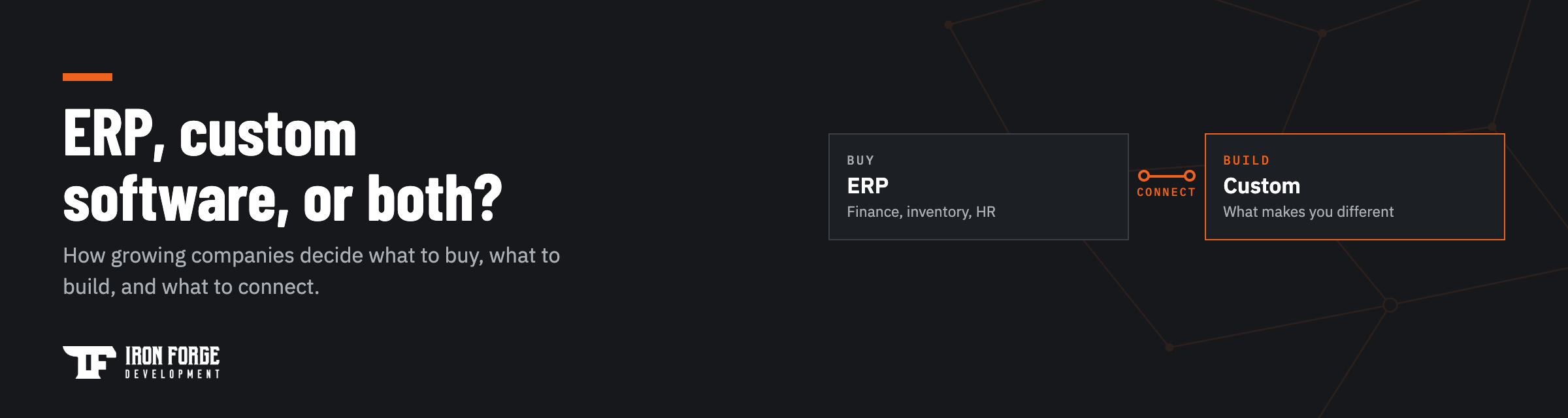
Most growing companies asking this question end up needing both. Buy a commercial ERP for the commodity parts of the business (accounting, inventory, purchasing, payroll), build custom software for the workflows that set you apart, and connect the two through the ERP's APIs. A full custom rebuild of your accounting system is almost never worth the money. Forcing your differentiating operations into a standard ERP module is just as expensive in the other direction, paid in workarounds instead of invoices. The real work is deciding which workflows belong on which side of the line, and that's what this guide walks through.
Where the question comes from
The decision tends to arrive at a predictable stage. Order volume, headcount, or SKU count outgrows the spreadsheets and entry-level tools that ran the early years, and someone proposes an ERP to bring everything under one roof. Then the demos start, and a pattern emerges: the ERP handles the standard work well and handles your distinctive work awkwardly or never. Nobody shops for new systems for fun. Something specific (a workflow, a report, a handoff between teams) is costing you hours or deals every week. Name that thing before you evaluate anything, because it decides most of what follows.
What an ERP does well
A commercial ERP (NetSuite, SAP, Microsoft Dynamics, and their peers) sells you standardized modules for problems every company shares. General ledger. Accounts payable. Purchasing, inventory counts, payroll. These are solved problems, and solved is exactly what you want to buy: the vendor keeps the software current with tax and compliance requirements, and thousands of other companies have stress tested every module before you. The price of that convenience is standardization. An ERP works best when your process bends to match the software, which is fine for bookkeeping and painful for the operations that make customers choose you. Pricing usually means a per-user subscription plus an implementation project to configure modules and migrate data, and the implementation is often the larger line item in year one.
What custom software is for
Custom software earns its cost where the workflow is the business. The scheduling logic that lets you promise delivery windows competitors can't match. The intake process that turns a messy customer request into a clean work order. The pricing engine that encodes fifteen years of estimating judgment. Off the shelf tools handle this work badly because no vendor built for your exact way of operating; our FAQ on when custom software makes more sense than an off-the-shelf tool covers the general test. Ownership is the other difference. A custom platform is an asset you own outright (we put code and IP ownership in writing), while an ERP subscription is rent that comes due every year and ends the moment you stop paying.
Sort your workflows before you shop
Before any vendor conversation, list the major workflows in your business and mark each one commodity or competitive. Commodity means a thousand other companies do it the same way and standard handling costs you nothing: bookkeeping, payroll, basic purchasing. Competitive means standard handling would actively hurt, which usually covers whatever your customers praise and whatever your operations do differently on purpose. Be strict about the split. Most teams find far more commodity than they expected, and the competitive list comes out short and sharp. That short list is your build list. Everything else is your buy list, and the exercise usually settles half the argument before anyone quotes a price.
The hybrid most growing companies land on
In practice, the strongest pattern keeps the ERP as the system of record and builds a custom layer on top. Finance, inventory, and orders live in the ERP, where audit trails and accounting integrity belong. The custom layer handles the differentiating work, reading from and writing back to the ERP through its APIs: a customer portal that shows live order status, a field app that closes out jobs and updates inventory, a quoting tool wrapped around your actual pricing rules. Integrations like this are routine work for us (our FAQ on integrating with the systems you already use names the usual suspects, from SAP to NetSuite to QuickBooks). The hybrid also dodges both classic failure modes. You don't rebuild solved back office problems from scratch, and you don't pay an implementation partner to bend the ERP into shapes the vendor never intended, a choice that turns every future upgrade into a project of its own.
When replacing the ERP is the right call
Sometimes a full replacement really is the answer, and the honest cases are narrow. The vendor has sunset the product and patches have stopped. The version you're running can't be safely upgraded. The system of record is failing at its one job of keeping books and counts you can trust. Outside those cases, replacement projects are long, disruptive, and expensive, and they tend to freeze every other initiative while they run. An ERP that's old but truthful can keep serving as the ledger while you modernize around it, one shipped workflow at a time.
What each path costs
ERP costs arrive in two layers: the subscription, usually priced per user per month, and the implementation, with its configuration, data migration, and training. Custom software is a capital project instead. Our projects start at $25,000, and a focused ERP build typically lands between $150,000 and $200,000 depending on the ERP scope, with larger multi-workflow platforms going beyond that; the full breakdown is in our custom software cost guide. Budget for the years after launch too. A well run custom platform costs roughly 15 to 20% of the build cost per year to maintain and extend, which is the number to weigh against a subscription that never ends.
How to decide with real numbers
Vendor demos won't settle this, and neither will a spreadsheet of feature checkboxes. A discovery engagement will. Ours is a fixed price, runs two to three weeks, and kicks off within 7 to 10 business days of signing. You leave with a requirements document, API recommendations (including exactly how a custom layer would talk to your ERP), development considerations, line item pricing, and a timeline. The deliverables are yours whether you build with us or with someone else. We've shipped 100+ products since 2017, and the buy-versus-build decisions that go well are the ones argued out on paper, against a written scope and a real price, instead of a year into an implementation.
Frequently asked questions
What's the difference between an ERP and custom software?
An ERP is a suite of standardized modules you buy, built for the back-office problems every company shares: accounting, inventory, purchasing, payroll. Custom software is built around your specific workflows and becomes an asset you own. The practical difference is fit. An ERP asks your team to adopt its processes, while custom software adopts yours. Sort your workflows by which ones would suffer from standardized handling: the commodity ones belong in an ERP, and the ones that win you customers usually justify a custom build.
When should you replace an ERP instead of building around it?
Replace an ERP only when it's failing at its own job as the system of record: the vendor has sunset the product, the version you're on can't be safely upgraded, or the financial and inventory data can no longer be trusted. If the ERP still keeps accurate books, build around it instead. A custom layer connected by API ships one workflow at a time, keeps the business running while it does, and costs far less than a rip and replace project that freezes everything else while it's underway.
What is a hybrid ERP and custom software approach?
A hybrid approach keeps a commercial ERP as the system of record for finance, inventory, and orders, then adds custom software on top for the workflows that set you apart, connected through the ERP's APIs. Think of a customer portal reading live order data, a field app writing back to inventory, or a quoting tool built around your pricing logic. You avoid rebuilding solved problems like accounting, and you avoid bending the ERP into shapes it was never meant to hold. For most growing companies this is where the decision lands.
How much does it cost to build custom software around an ERP?
Custom projects at Iron Forge start at $25,000, and a focused ERP build typically runs $150,000 to $200,000 depending on scope and the depth of the ERP integration. Plan on roughly 15 to 20% of the build cost per year in maintenance to keep integrations healthy as the ERP and your product evolve. Before you commit, a fixed price discovery engagement defines the scope and produces line-item pricing and a timeline, so you're deciding with a real number instead of a range.
Trying to decide what to buy and what to build? A discovery engagement maps your workflows, defines the custom layer, and gives you line-item pricing and a timeline before you commit to either path. Book a strategy call to talk through where your systems are today.
Written by the team at Iron Forge Development, a U.S.-based software commercialization firm that has helped launch 100+ products from idea to market.