

Best US Agencies to Rebuild Existing Mobile Apps
Six US mobile app agencies compared on takeover experience, modernization judgment, design depth, and post-launch support, plus what to ask before you hand over an existing app.
October 15, 2026
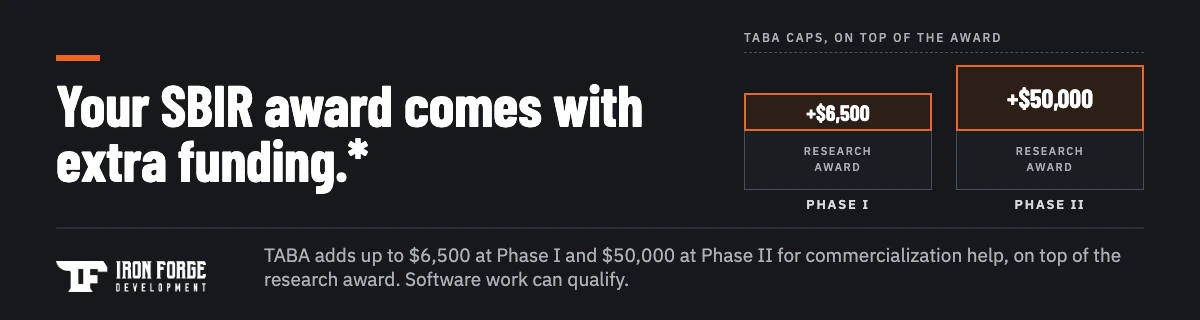
If your company holds an SBIR or STTR award, you can request extra federal money specifically for commercialization help. It's called Technical and Business Assistance, or TABA: up to $6,500 on a Phase I award and up to $50,000 on a Phase II award, on top of the research funding itself, to pay an outside vendor that helps you turn funded research into a product that sells. Most awardees spend it on market research reports and IP strategy. Fewer realize that software-centric commercialization work (defining the product, prototyping it, building the production version) can qualify too. One caveat before anything else: every agency administers TABA differently, so your own agency's current solicitation is the final word on amounts, timing, and process. Treat everything below as the general shape of the program and confirm the specifics with your program office.
Congress created TABA in the John S. McCain National Defense Authorization Act for fiscal year 2019, and the SBIR/STTR reauthorization signed in April 2026 extended the program and widened what it covers. The idea is simple. Agencies fund research through SBIR and STTR, but research alone doesn't become revenue. TABA lets awardees bring in outside help for the commercial side of the project without raiding the R&D budget, because TABA dollars are requested separately from, and in addition to, the research award.
The statute frames the purpose in four parts: making better technical decisions on the project, solving technical problems that come up during it, minimizing technical risk, and developing and commercializing the new products and processes that result, including intellectual property protection. The 2026 reauthorization added further allowable uses, such as staff training and screening for foreign involvement in your technology. That last clause of the original four, commercializing the resulting products, is the one that matters for this article. For a software company, commercializing means shipping working software.
The established TABA vendor ecosystem sells business services: market assessments, customer discovery studies, commercialization plans, IP landscape reports, manufacturing strategy. Several agencies keep a default provider on contract for exactly this kind of work, and if that's what your project needs, it's a sensible way to use the money. A strong commercialization plan also strengthens a Phase II application, so Phase I TABA often goes toward producing one.
What you won't find much of in that ecosystem is anyone who builds product. The dominant TABA deliverable is a report. Reports are useful for deciding what to do. They don't put software in front of a customer.
Here's the gap worth talking about. For most SBIR and STTR software projects, the thing that proves commercial viability isn't another document. It's a product a real customer can log into: the self serving version of your research prototype, the pilot deployment a partner can run, the production build that survives real world users that were not part of your initial demo. Work that gets you there (product definition, UX design, prototyping, production grade development of the initial commercial version) is commercialization work in the plain sense of the statute's language about developing and commercializing the products that result from your research.
Two honest hedges. First, each agency interprets eligible TABA uses through its own solicitation, and some scope the assistance more narrowly than others, so frame the request in commercialization terms and confirm it with your program office. Second, TABA pays for assistance with commercializing the funded technology; it isn't a general purpose development subsidy for unrelated products. If the build you're scoping is the commercial expression of the research the agency funded, you're in the right conversation. If it isn't, you're not.
It's also worth knowing there is no federally approved list of TABA vendors. You propose the vendor, and the agency reviews the request. Common requirements, NASA's version being a clear example, are that the vendor must be a legal U.S. business and can't be your own company, an employee, or an affiliate or investor of your business. A software commercialization firm that meets those tests can be proposed like any other vendor.
The two caps aren't just different amounts. They suit different work. A Phase I project is short and its question is feasibility, so $6,500 of TABA is best spent on definition: what the commercial product would actually be, what it would cost to build, and in what order. That's scoping and defining the requirements of the product, and done properly it produces documents an evaluator can read and easily understand.
Phase II is where development and demonstration live, and $50,000 of TABA can fund product work itself: design, prototyping, and a real share of production development on the commercial version. Awardees who used Phase I TABA on scoping arrive here with a priced plan already in hand, which makes the Phase II request concrete instead of aspirational. Eligibility at Phase II generally doesn't depend on having used TABA at Phase I, so it's not too late to start at either point. Check your agency's rules on both.
The mechanics vary by agency, which is the single most important thing to internalize about this program. As of this post, the general patterns look like this:
So the practical sequence is: read the TABA section of your agency's current solicitation first, decide what assistance would genuinely move your commercialization forward, pick a vendor who can put that work in writing, and build the request into the proposal with a line-item budget. If you're already past submission, ask your program office what's still possible rather than assuming the door is closed.
TABA's caps make fixed-price work unusually easy to justify, because the request needs a specific dollar figure and a described deliverable. Our Discovery engagement is $1,199, fixed, and produces a requirements document, API recommendations, development considerations, line-item pricing, and timelines in two to three weeks. That fits inside the $6,500 Phase I cap with most of the cap to spare, and the deliverables double as commercialization evidence for a Phase II application: a written, priced plan for the product your research becomes.
At Phase II, the $50,000 cap covers Discovery plus a meaningful share of an actual build. Focused first versions of custom software typically run $25k to $75k, a range we break down in our custom software cost guide, so a Phase II TABA request can fund the scoping and a real portion of the production work, with your research award untouched. Where the full build exceeds the cap, the TABA-funded scope gives you an exact number for what remains, which is a far better position than estimating.
If the word commercialization still feels abstract, our guide to what software commercialization actually means walks through the full idea-to-revenue path; TABA is simply a federal mechanism that pays for help along that path. And if your organization is weighing grant-funded development more broadly, we've answered whether a grant can pay for custom software development separately.
Your TABA vendor goes into a federal proposal under your company's name, so vet them the way the agency will. A few questions will help do most of the sorting:
Ask those four questions and the TABA specific risk mostly disappears. What's left is ordinary vendor selection, which you were doing anyway.
Holding an SBIR or STTR award and wondering what your technology becomes as a product? A fixed-price Discovery produces exactly what a TABA request wants to see: defined deliverables, a line item fixed development price, and a timeline, in writing. See what the Discovery package includes or get in touch to talk through your Phase I or Phase II timing.
Written by the team at Iron Forge Development, a U.S.-based software commercialization firm that has helped launch 100+ products from idea to market.
Six US mobile app agencies compared on takeover experience, modernization judgment, design depth, and post-launch support, plus what to ask before you hand over an existing app.

Six US software commercialization companies compared on strategy, design, engineering, and post-launch support, plus the five questions that sort any shortlist before you sign.
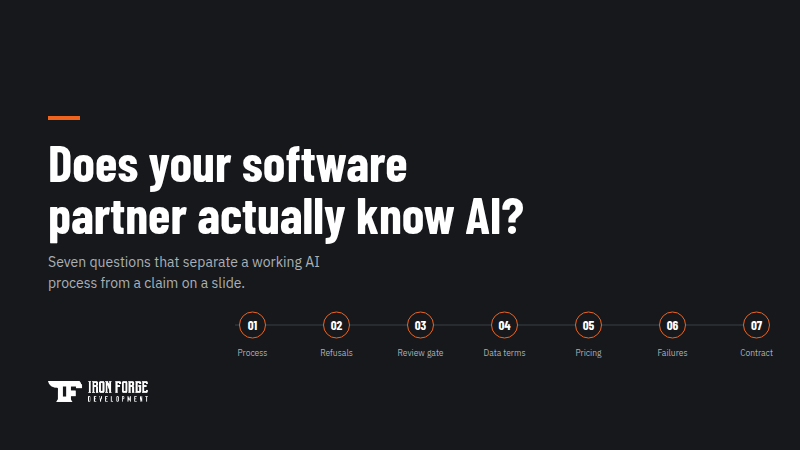
AI maturity is now a standard line on vendor scorecards. Here are the seven questions, the red flags, and the contract clauses that show whether a software partner actually knows how to use AI.


