For most companies building their first product, or building software alongside a core business that isn't software, a development partner costs less than hiring an in-house team, and the gap is wider than the hourly-rate math suggests. Hiring wins on cost only once software becomes a permanent, central part of how your company operates, with enough continuous work to keep multiple specialists busy for years. The comparison that actually matters is total cost to a shipped, supported product, and that's the comparison this guide runs.
To be clear about the bias you should assume: we're a development partner, so read accordingly. We've also helped clients stand up their own teams and handed off codebases built for exactly that, so we've watched both columns of this spreadsheet play out.
The comparison most people run, and why it misleads
The instinctive math puts a developer's salary against an agency's pricing and calls it a day. A salary looks cheaper per hour than any partner's effective rate, so hiring looks like the frugal choice.
That math compares inputs. You aren't buying hours, you're buying a working product, and the two columns behave very differently on the way there. The salary column quietly excludes most of its own costs, and the partner column includes nearly all of them. Correct for that, and the picture usually flips for a first build.
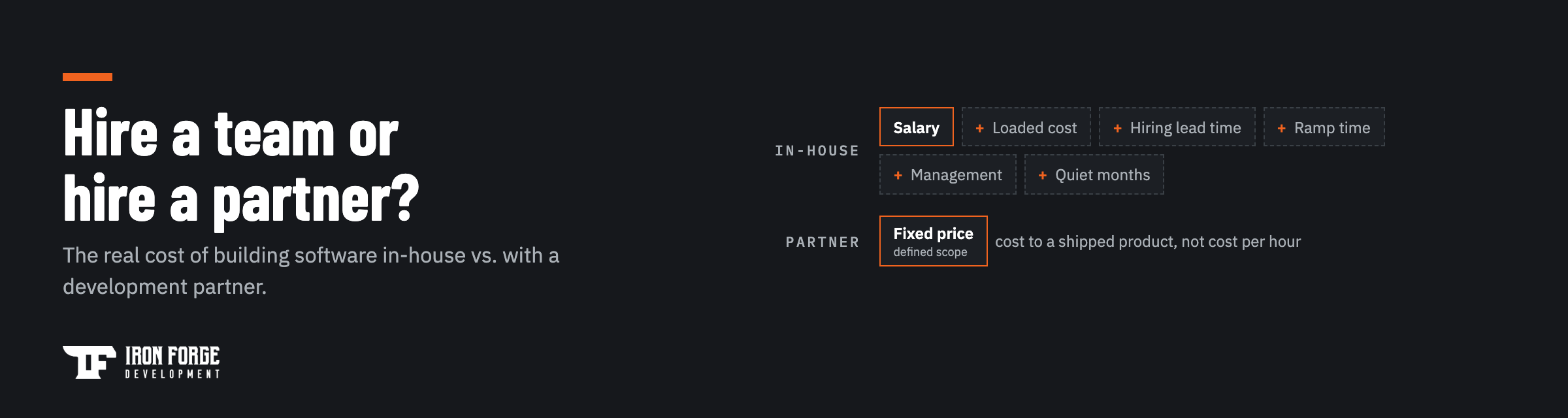
What an in-house team really costs
Salary is the visible line. The full column looks like this:
- Loaded cost. Payroll taxes, benefits, equipment, software licenses, and recruiting fees stack meaningfully on top of every base salary. The true annual cost of an engineer runs well past the number in the offer letter.
- Hiring lead time. Finding, interviewing, and closing a good engineer takes months, and the product doesn't move while the seat is empty. A bad hire resets the clock and burns the loaded cost twice.
- Ramp time. New hires produce below their cost for their first stretch while they learn your domain. That's normal. It's also money.
- One person is not a product team. A real product needs design, frontend, backend, infrastructure, QA, and someone directing the work. One hire covers a slice or two. Cover it all and you've built a department.
- Management overhead. Somebody has to set direction, review work, and make architecture calls. If nobody on staff can evaluate technical decisions, you've added a leadership gap to the payroll.
- The quiet months and the exit. Payroll runs whether or not the roadmap is full, and when your only developer leaves, their context leaves too. Plenty of software rescues start exactly that way.
None of this argues that hiring is wrong. It argues that hiring is a commitment shaped like a department, and it should be priced like one before you compare it to anything.
What a partner really costs
A partner's cost is more visible, which ironically makes it look worse. The quote has a number on it. Payroll never does.
With a discovery-first partner, the structure works like this: a scoping engagement defines what you're building, then you get a fixed price for the build. Our version is a fixed price Discovery that runs 2-3 weeks and ends with a requirements document, development considerations, and line-item pricing with timelines. Focused first versions typically land between $25,000 and $75,000, and our cost guide breaks down what moves the number within and beyond that range.
What that price includes is the part the hourly comparison misses: a full team (strategy, design, engineering, QA) that starts within days rather than months, already knows how to work together, and stops costing you money the moment the scope ships. After launch, plan on the standard 15-20% of build cost per year for maintenance, whether through a membership or your own eventual hires.
Speed is a cost line too
Time rarely makes it into the spreadsheet, and it belongs there. Every month between deciding to build and shipping is a month of the problem going unsolved: revenue not collected, hours not saved, a competitor's head start growing. The in-house path front-loads its slowest work, since recruiting and ramping happen before the first feature exists. The partner path front-loads its fastest, because the team already exists and starts once the scope does.
For a first build, that difference is commonly measured in months. Price those months in whatever unit your business feels most, and add the result to whichever column earned it. For plenty of companies, the speed gap alone settles the question before the payroll math even starts.
Where in-house wins
In-house teams earn their cost in specific conditions. The roadmap is continuous, with years of work visible and no natural pause. Software is the business, so product knowledge compounding inside your own walls is a strategic asset rather than a convenience. You need daily, on-call ownership woven into company operations. Or you're at a scale where the work would fully occupy several specialists anyway, and the partner premium buys flexibility you no longer need.
If that describes you, hire. Just notice that it describes companies with a proven product and steady demand for engineering, which is almost never the situation at the first build.
A stage-based way to decide
The decision tracks stage more than preference:
- Validating an idea. Partner, and a small engagement at that. Hiring a team to test demand is the most expensive way to learn the answer was no.
- First build. Partner, for speed and cost certainty. A fixed price against a defined scope beats assembling a department on faith.
- Live product, growing demand. Either, and often both. Keep a partner on the roadmap while you make your first technical hires without pressure.
- Software is the core business at scale. In-house center of gravity, with partners for surges and specialties.
- Enterprise team with an innovation project. Partner, usually. Internal engineering queues exist for the core product. A ring-fenced build with its own team ships while the queue debates priorities.
If you're weighing what kind of technical leadership you need alongside delivery, our guide to fractional CTOs versus development partners covers that split.
How to run the numbers on your own project
The comparison only works against a defined scope, and that's the step most companies skip. "An app" can't be priced in either column. A written scope can be priced in both.
So define the product first. That's what a discovery engagement is for: it turns the idea into a requirements document with line-item pricing and timelines, which gives you the partner column of the spreadsheet as a set of real numbers instead of a guess. Then build the in-house column honestly against the same document. Which roles does this scope require, what do those hires cost loaded, how long until they're all seated and productive, and what does the calendar look like from signing offer letters to shipping.
Run that exercise and you get a decision instead of a debate. The same document also protects you in the other direction: if you do hire, the requirements doc becomes your team's first spec, and if you take quotes from other partners, it makes every quote comparable. Scope-first pricing is the rare move that pays off no matter which column wins.
The hybrid path most companies actually take
The choice isn't permanent, and treating it as either-or is how companies get stuck. The pattern we see work: a partner builds the first product against a fixed scope, the business proves itself on revenue instead of burn, and hiring starts when the sustained workload justifies it. Done right, the handoff is boring. You own the code and the IP outright from day one, the documentation is written for whoever comes next, and the partner shifts to a support role or steps away cleanly.
Ask any partner you're evaluating how that exit works before you sign. A firm that plans for your future team is safe to start with. A firm that gets cagey about code ownership or documentation is answering a different question, and our guide to choosing a development partner lists the rest of the checks worth running.
Trying to price a build before you decide who does it? A fixed-price Discovery gives you a defined scope, line-item pricing, and timelines you can hold any team against, in-house or ours. Or talk it through with us first.
Written by Jeremy Millian - COO of Iron Forge Development, a U.S.-based software commercialization firm that has helped launch 100+ products from idea to market.